Why Construct Concrete Slab with Bubbles

- Written by Eduardo Souza
- August 25, 2020
In the dome of the Pantheon in Rome, several construction techniques were used to allow such a bold construction to stand. One concerns the composition of the concrete (in this case, non-reinforced concrete) with different densities throughout the structure. Closer to the top, lighter stones were used in the mixture, reducing the dome’s weight retaining the solidity of the base.
Another technique was the inclusion of “coffers”, which are nothing more than subtractions in the concrete, reducing the weight of the dome while maintaining a cross section sufficiently robust to support its own weight. Built almost 1,900 years ago, this building still surprises us with the genius of the solutions. Using a quantity of materials just high enough to fulfill its primary function, and creating intelligent structures as a result, is just one of the lessons that this building provides.

Concrete is one of the most commonly used materials in the construction industry. However, the production process of concrete consumes large amounts of energy and non-renewable natural resources, while simultaneously emitting considerable amounts of gas that only contribute to the worsening of the planet’s greenhouse effect. Looking for ways to make its use in buildings more eco-conscious, while still taking advantage of its structural characteristics, is a first step towards the more sustainable future of civil construction.
For this reason, it is important to understand both the potential of concrete and its weaknesses. In the case of concrete slabs, a major disadvantage of the material is its considerable weight, which limits larger spans of concrete at the risk of the structure collapsing. Concrete has good resistance to compression, but very little resistance to tension. Thus, reinforced concrete uses steel to support the slab from against acting tensile forces.


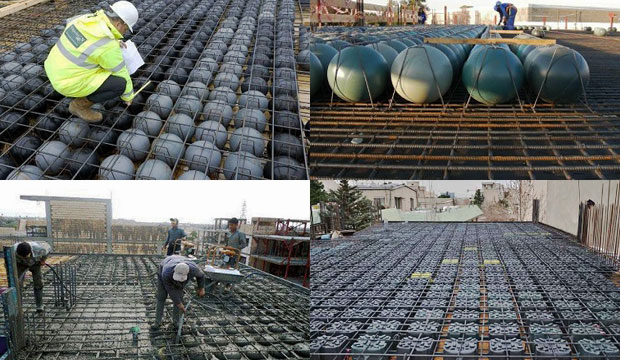
In precast, hollow, or ribbed slabs, part of the space that would otherwise be occupied by the concrete is left empty or filled with a material of less weight, such as ceramic bricks or expanded polystyrene. A similar approach was developed in the 1990s by Jorgen Bruenig, who developed in Denmark a type of biaxial hollow slab (today better known by the BubbleDeck trade name). It is a system composed of hollow spheres made of plastic, which occupy places where the concrete has a less important structural function, such as in between columns. The spheres, inserted uniformly between upper and lower steel reinforcements, fill with air the space that would otherwise be occupied by concrete serving little structural function and adding significant weight. With this system, it is possible to reduce between 25% and 35% of the slab’s own weight (compared to a solid slab of the same thickness), allowing for larger spans, reducing the section of the columns, and decreasing overload on the building’s foundations. It is estimated that the use of 1 kg of plastic for the spheres saves about 100 kg of concrete.


Also called biaxial hollow core slabs, the properties and behavior of this material are similar to that of massive concrete slabs, since the forces are transferred in both horizontal directions to the pillars and foundations. They can be built using modules, pre-slabs, or finished panels. They require less shoring than solid or even ribbed slabs, allowing the construction to move faster. Using prefabricated components can also significantly reduce the need for labor, resulting in even faster and cheaper construction.
The spheres can be composed of recycled polypropylene material or polystyrene, with low specific weight and good resistance. After the concrete is poured, the piece appears to be a traditional solid concrete slab and the spheres remain in the structure. Research and tests have demonstrated this technique’s strong acoustic quality and fire resistance as well. Evidently, however, it is a system that requires more attention to detail, particularly when designers have to adapt the existing dimensions to new design demands. Another limiting issue is that in some countries, there are still no regulations specific to this system, or enough labor with adequate experience in this method.

In recent years, this technique has been widely applied to large-scale projects, such as educational buildings and even airports, where deadlines are tight and budgets permit investing in new methods. Searching for sustainable solutions may mean creating new materials and new technologies, but it can also be as simple as using the same material in more intelligent, conscious, and efficient ways.



You really make it appear so easy together with your presentation however I find this topic to be really something which I think I would never understand. It seems too complex and very large for me. I’m taking a look forward on your next post, I’ll try to get the hold of it!
I’m just commenting to let you know of the notable experience my friend’s daughter had visiting your web site. She figured out lots of pieces, most notably what it is like to possess an awesome coaching style to make men and women with ease gain knowledge of selected extremely tough subject matter. You truly surpassed visitors’ desires. Thank you for providing those warm and friendly, dependable, explanatory and in addition cool guidance on that topic to Julie.
I like what you guys are up also. Such clever work and reporting! Keep up the superb works guys I have incorporated you guys to my blogroll. I think it will improve the value of my site :).
Мне понравилась организация информации в статье, которая делает ее легко восприимчивой.
Эта статья – источник вдохновения и новых знаний! Я оцениваю уникальный подход автора и его способность представить информацию в увлекательной форме. Это действительно захватывающее чтение!
Spot on with this write-up, I seriously believe this web site needs a lot more attention. I’ll probably be returning to see more, thanks for the information!
I respect your piece of work, thankyou for all the good blog posts.
Definitely imagine that that you stated. Your favorite justification appeared to be on the web the easiest factor to be mindful of. I say to you, I certainly get irked even as people think about worries that they just don’t understand about. You managed to hit the nail upon the top and also defined out the whole thing without having side-effects , other folks could take a signal. Will likely be back to get more. Thank you
I was studying some of your articles on this site and I believe this internet site is very informative ! Keep putting up.
Enjoyed examining this, very good stuff, appreciate it.
I like what you guys are up too. Such smart work and reporting! Carry on the superb works guys I?¦ve incorporated you guys to my blogroll. I think it will improve the value of my site 🙂
Hi! I know this is kind of off topic but I was wondering which blog platform are you using for this site? I’m getting tired of WordPress because I’ve had issues with hackers and I’m looking at options for another platform. I would be awesome if you could point me in the direction of a good platform.
Hello my friend! I wish to say that this article is awesome, nice written and include approximately all important infos. I?¦d like to peer extra posts like this .
I feel that is among the such a lot important info for me. And i’m glad reading your article. However want to statement on few normal issues, The site style is great, the articles is in reality nice : D. Good job, cheers
That is the right blog for anybody who wants to search out out about this topic. You notice so much its nearly laborious to argue with you (not that I truly would want…HaHa). You positively put a new spin on a subject thats been written about for years. Great stuff, just nice!