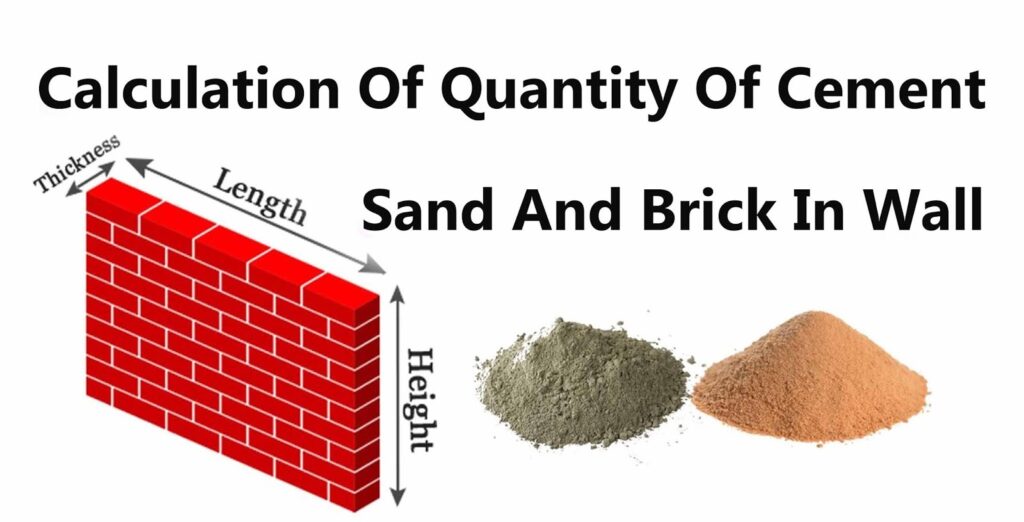
Assuming
1- Grade of mortar = 1:6 (cement : sand)
2- Class A brick (19 cm x 9 cm x 9 cm)
3- Volume of brick work = 1.0 m^3, (wall size =1*1*1 =1.0 m^3)
4- Thickness of mortar = 10 mm
Step 1 :- Calculation of bricks
No. of bricks = (volume of brick work / volume of one brick with mortar)
Volume of one brick (without mortar) = .19*.09*.09 = 0.001539 m^3
since thickness of mortar = 10 mm (0.01 m)
Volume of brick with mortar = (0.19+0.01) x (0.09+0.1) x (0.09+0.1) = 0.2×0.1×0.1 = 0.002 m^3
Number of brick required in brick work volume = 1.0 m^3
therefore,
No.of bricks = 1.0/ (0.002) = 500 Nos.
consider the percentage of waste as 10 % or 15 %
Total no. of bricks = 500 + (10 x 500 )/100=550
Step 2 :- Calculation for quantity of mortar
Since we need 500 no of bricks
volume occupied by bricks = No of bricks x volume of one brick
Volume of bricks = 500 x 0.001539 = 0.7695 m^3
Volume of mortar = Volume of brick work – Volume of Bricks
therefore,
volume of Mortar = 1.0 – 0.7695 = 0.2305 m^3
Step 3:- Calculation for Quantity of Cement
Cement = (dry volume of mortar x Cement ratio)/ sum of the ratio,s(proportion)
Dry volume of Mortar = 1.33 x 0.2305 = 0.3065 m^3 ( 33% increment due to volume shrink after water addition )
Vol. of cement= (0.3065 x 1) / (1+6) = 0.3065/7= 0.043795 m^3
cement (kg) = 0.043795 x 1440 = 63.0648 kg
No. of bags = 63.0648 / 50 = 1.26 bags approximately 2 bags
Step 4 :- Calculation for Quantity of Sand
Sand = (dry volume of mortar x Sand ratio)/ sum of the ratio,s(proportion)
Sand = 0.3065*6/7 = 0.2627 m^3
or
sand = cement volume x 6 ( since 1:6 grade of mortar)
Sand = 0.043795 * 6 =0.2627 m^3
sand = 0.2627 x 1920 = 504.384 kg /1000 = 0.5043 tonnes or
sand = 0.2627 x 35.3147 = 9.27 cft or
sand = 0.2627 x 0.354 = 0.0930 brass
So, For
- Grade of mortar = 1:6 (cement : sand)
- Class A brick (19 cm x 9 cm x 9 cm)
- Volume of brickwork = 1.0 m^3
- Thickness of mortar = 10 mm
Number of Bricks = 500
Cement = 1.26 bags of 50 Kg
Sand = 0.2627 m^3
]]>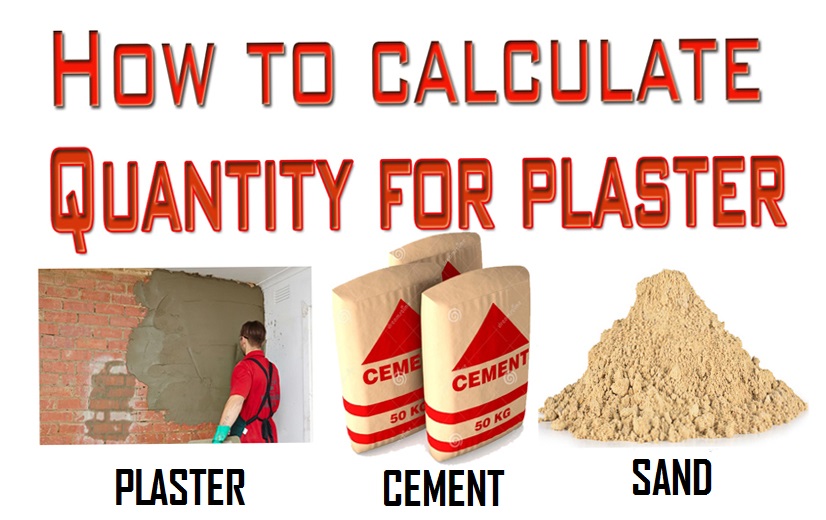
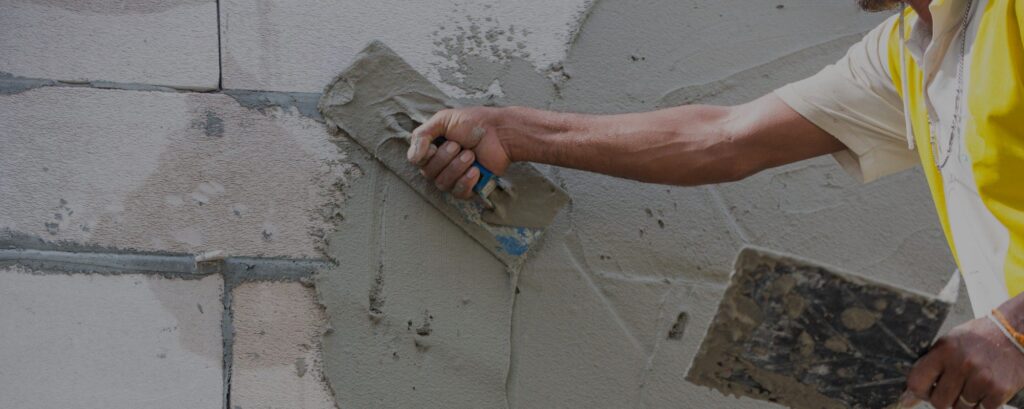
Plaster is a building material used for the protective or decorative coating of walls and ceilings and for moulding and casting decorative elements.
In English “plaster” usually means a material used for the interiors of buildings, while “render” commonly refers to external applications. The most common types of plaster mainly contain gypsum, lime, sand or cement, but all work in a similar way. The plaster is manufactured as a dry powder and is mixed with water to form a stiff but workable paste immediately before it is applied to the surface.
The reaction with water liberates heat through crystallization and the hydrated plaster then hardens. Plaster can be relatively easily worked with metal tools or even sandpaper, and can be moulded, either on site or to make pre-formed sections in advance, which are put in place with adhesive. Plaster is not a strong material; it is suitable for finishing, rather than load-bearing, and when thickly applied for decoration may require a hidden supporting framework, usually in metal.
Notes
1- Cement Mortar Ratio for wall plastering 1:6
2- Cement Mortar Ratio for ceiling plastering 1:4
3- Plastering thickness should not be more than 12-15 mm. If there is a need for an additional coat don’t do that at one go.
4- Ensure you are using good quality of cement & Sand.
5- Ensure you are using measuring box (not head pan) for site mix.
Example
Given that:
Ratio: 1:4
L= 6 M
H = 3 M
Thickness of Plaster = 12 mm
Volume of plaster = L * H * Thickness
Volume of plaster = 6 * 3 *0.012 = 0.216 m3
Dry Vol. =Wet Vol. * 1.27 ⇒ 0.216 * 1.27 = 0.274 m3
Vol. of cement = 1/5 * 0.274 = 0.054 m3
Density of cement = 1440 kg per cubic metre
Vol. of cement = 0.054 *1440 = 78 kg
One bag of cement have 50 Kg
Vol. of cement = 0.054 *1440/50 = 78 kg
Vol. of sand =4/5 * 0.274 = 0.21 m3
]]>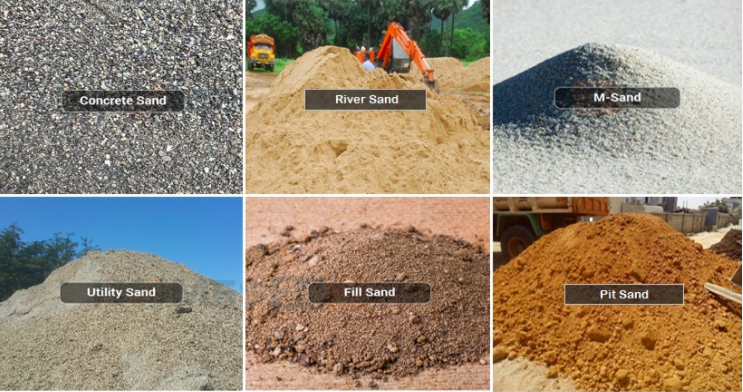
Sand is the primary material used in the construction of any building. There are many types of sand used in construction that provides strength and other properties to construction materials making the building strong and rigid. Construction Sands and Gravel are extensively used to prepare concrete that goes into the construction building.
Since sand can be easily compressed, it is widely used for wall reinforcements and in certain types of grounding or flooring. However, sand should be mixed with other materials in the correct amount. If the amount of sand used exceeds the prescribed amount, the sand may become heavy and will not produce the desired result.
It becomes less stable and less resistant. While choosing sand for building construction, it is most important to choose the ones, which don’t have small rocks, particles or other impurities. Let’s look at a few types of sand used in construction!
1. Concrete sand
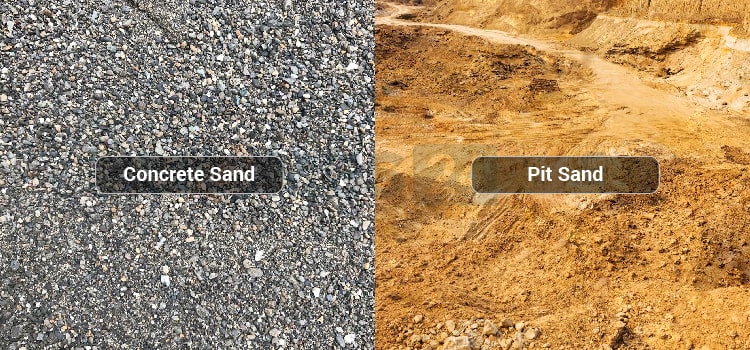
Concrete Sand is one of the types of sands in India that is made from crushed concrete. It is a common component in cement and asphalt mixtures. This sand is crushed in the quarry and filtered to remove the large rocks and huge fragments. It is a type of coarse sand that can be mixed with cement and water and then used as leveling base for layers, patios, and walking paths. When mixed with cement and water, it forms a solid mass that is used to fill the voids between the coarse aggregates. It is smaller-grained when compared to crushed stone sand and hence can be used to construct softer pavements. However, it is also larger than white sand and hence can be used as a filling material too. The size and texture of this sand make it an ideal material for a lot of purposes. It provides fundamental stability to a building.
2. Pit sand
Pit Sand is a type of sand used in construction that is best used for constructing buildings due to its superior binding property. It is coarse sand that is found 2-3 meters under the ground. It is obtained naturally from deep pits. It consists of rough, sharp, angular, and coarse grains that provide excellent binding properties. They appear in red-orange due to the presence of iron oxide. The grains of this construction sands is free from salts and hence they don’t easily react with the moisture present in the atmosphere. Due to this property, they provide a strong and rigid building.
3. River sand or Natural sand
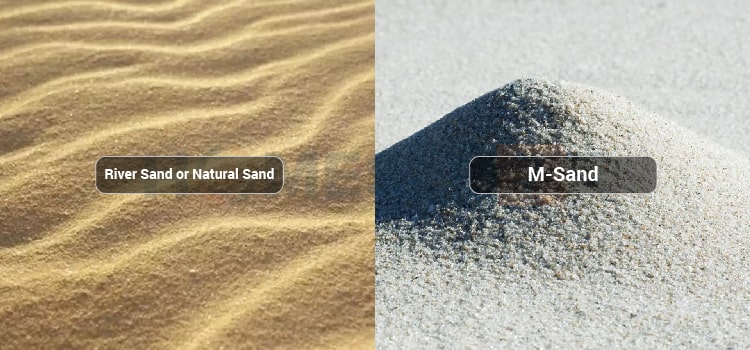
River sand falls under the fine quality of construction sands, which is found near river banks and streams. This sand is white-grey and is one of the fine graded sands used in the construction of buildings. They are mainly used in concrete and masonry work. They can also be used for RCC, plastering, and much other brick or block works. This sand consists of a smoother texture and a better shape of grains. The river or natural sand demands very less water. The moisture, which is trapped between these particles, serves good for various concrete purposes. Medium quality river sand consists of 5 to 20% of silt content in them.
River sand since naturally obtained is cheaper. These types of sand used in construction contain silica content in them. Therefore, it is necessary to check for the amount of silica present and ensure it is below 5%, before using it for construction.
4. M-sand
M-sand stands for Manufactured sand and is one of the types of sand used in construction in India. This type of construction sand is manufactured in the factory. It can be used as a substitute for river sand for concrete construction. Manufactured sand has been used ever since the demand for good quality sand has increased rapidly. This type of construction sand is prepared by crushing hard granite and hence it reduces transportation costs of bringing sand from riverbeds. It contains particles of angular nature, which increases the strength of concrete. These angular particles present in the sand increase its water demand. This water demand can be compensated by adding cement content. Since it is artificially manufactured, it contains zero silt content. There are no oversized materials found in these types of construction sand.
This is a type of construction sands that is easily available too. Since it manufactured and not natural, it can be free from several impurities and the sizes of the sand grains can be controlled as desired which suits each purpose. Since they are manufactured in a controlled environment, there is very little probability of adulteration of this sand and there is better control over the manufacturing quality of the M-sand. The M-sand provides good durability and imparts high strength to concrete. It is very economical and reduces construction defects.
5. Utility sand
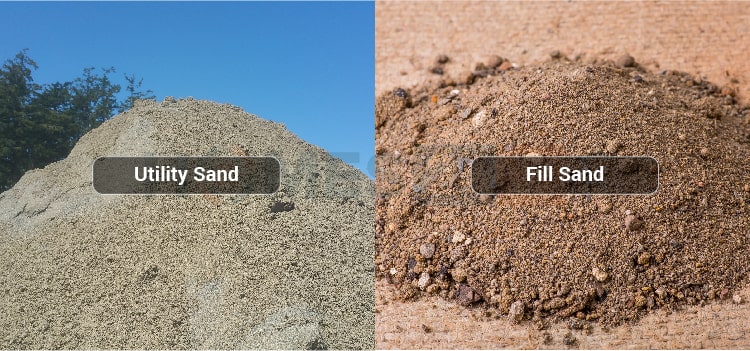
Utility sand is a types of sand used in construction. This type of sand is produced from industrial quartz of high quality. This type of construction sand provides excellent compaction and good mechanical properties due to its uniform grain shapes. It can be used in corrosive environments since they are non-reactive. They contain 100% natural minerals which provide excellent durability and stability to the building.
6. Fill sand
The Fill sand is a types of sand used in construction, mainly for filling. It is a combination of many grains of sand and aggregates. It consists of very fine rock particles that have been broken down and undergone erosion. It can be primarily used as a base material for laying concrete, paving, and filling large holes. Its properties of excellent compaction make it the perfect base material for several purposes during the construction of a building. It provides a lot of advantages when used in wet areas to fix drainage problems by serving as backfill around septic tanks.
While choosing the types of sand used in construction of a building, it is essential to consider certain factors. The sand should contain less than 3% silt content, it should be free from organic materials and it should not contain any kind of impurities. Moreover, each type of sand provides different properties, which should be analyzed well before using them for construction purposes. Listed above are a few of the best types of sand used in the construction of building. Choose the right construction sands to build strong!