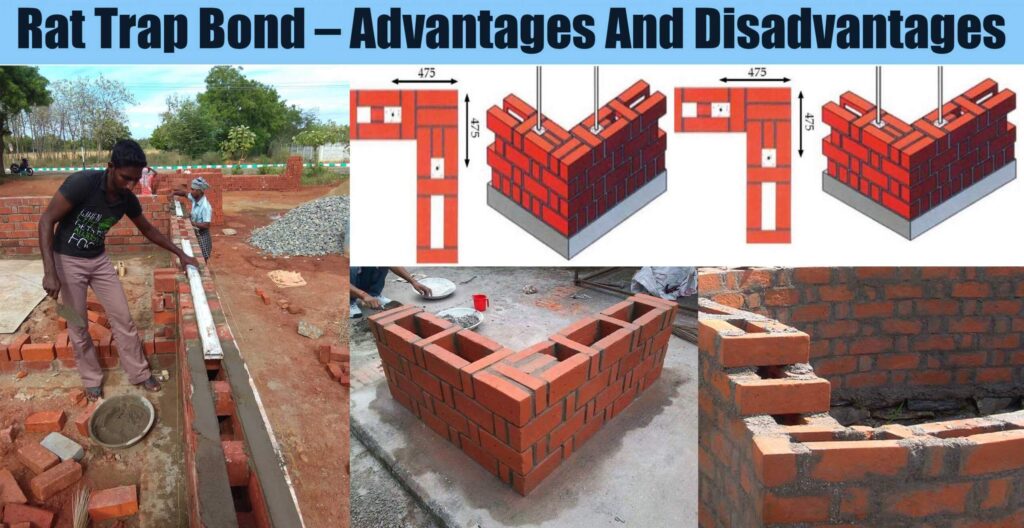
This is one of the wall constructing method of brickwork on wall construction. This method is having slight differences while placing bricks during brickwork; furthermore, it is working on a void making principle.
It means there is space between two blocks when placing on layer. Bricks position in this method is vertical, so brick face with fog remains remain inner face where hollow space created due to the upright position of the bricks.
This kind of new pattern of bricklaying introduced by Mr.laurie Baker in the 1970s in Kerala. The primary purpose of this idea was to draw down cost in the material in construction as much as possible moreover, parallelly, it decreased in material requirements, and also it provides excellent thermal efficiency when it compares to the older pattern of brick masonry.
The main thing that needs to note down is that due to this method, the strength of the wall not affected.
How to Use Rat Trap Bond Method Practically?
- This method is less prominent due to people accustomed to the conventional way of brickwork. At present, these types of masonry construction are new in many areas.
- In this type of bricklaying pattern, bricks are situated on edges; hence face with fog remains inside of the wall, and it built a small rectangular section of four blocks.
- Due to this, the wall has an inside void or free space, which plays a vital role in getting effective thermal insulation inside the room.
Advantage of Rat Trap Bond Method
Here, the pros of rat trap bond methods are as follows.
- This method is adaptable on the basis of its less consumption of construction material means it provide benefits in material costing.
- This method consuming roughly 30% fewer bricks moreover 50% less mortar compare to conventional masonry.
- Most people avoid using this method due to the unawareness of this method. However, the strength is as equal as an old method of bricklaying.
- If considering the main benefit of this method is thermal insulations, it is beneficial to decreased room temperature, and it reduces electricity costs.
- This way of bricklaying method is playing a crucial role in resisting heat and cold in both weather conditions.
- This bricklaying pattern in the construction is eye-catching from both inside and outside of the wall; the plastering process is avoidable if it is not necessarily
- Well, this brick laying method also used in partition wall; moreover, even capable of holding a load on it means its load-bearing capacity is not affected.
- This way is very well useful in case of decreasing material cost; It reduces material consumption, which results in cost saving in the construction budget.
Disadvantage of Rat Trap Bond
Here, the cons of rat trap bond methods are as follows.
- This way of construction is not capable of resisting sound. Hence, the soundproof wall is not possible b this way.
- Mason has to be careful while laying bricks. Extra care must be taken while designing the wall length and heights for a structure.
- Pre-training required if workers are not familiar with this pattern of bricklaying, if not possible, then hired experienced workers; hence the cost of a worker may increase.
Points to Be Considered in Construction for Rate Trap Brick Bonds
Following Care Should Be Taken While Using This Pattern:
- Firstly, the quality of bricks is always checked before used, quality with regular size, and even sharp edges.
- The surface layer or first bottom layer and last or topmost layer of the wall should be solid where no use of vertical bricks.
- Other areas, like sill and lintel levels at opening or sides of opening have to be solid, so it is easy to provide strength to fix frames for door and windows.
- If the building requires more power than we can adopt reinforcement bars to place vertically at hollow space and corners and also at around openings of doors to resist earthquake effects o building.
- In this case, advanced planning and smart work required to installed electrical appliances and plumbing pipes.
- Sum up all things, this way of construction has overall cost in saving on cost is about 25% of a used by building value by traditional 9inch brickwork construction.
- As per the experiment or survey, 350 bricks per CFM in the old method, while in this, it required only 250 blocks; moreover, mortar consumption also decreased, so it affects the building budgets directly.
FAQ
Rat Trap Bond
Rat trap bond is a brick masonry method of wall construction, in which bricks are placed in vertical position instead of conventional horizontal position and thus creating a cavity (hollow space) within the wall.
What Is Rat Trap Bond Used For?
Rat trap bond is a brick masonry method of wall construction, in which bricks are placed in vertical position instead of conventional horizontal position and thus creating a cavity (hollow space) within the wall.
Is Rat Trap Bond Load Bearing?
Walls constructed using rat trap bonds can be used both as load-bearing walls as well as thick partition walls. Rat trap bond technique is relatively durable and maintenance cost is also lower
Rat Trap Bond Masonry
Rat trap bond is a modular type of masonry bond in which the bricks are placed in a vertical position, creating a cavity in the wall while maintaining the same wall thickness as the conventional brick masonry wall. It is also known as a Chinese brick bond.
Who Developed Rattrap Bond?
The rat-trap bond was invented and popularised the famous architect Laurie Baker. This system uses bricks-on-edge with a cavity behind every facer brick. Each course of brickwork is 115mm high, comprising of two parallel facers followed by brick placed at 90o to lock the bond. In the next course, the vertical mortar joints are broken by spanning the cavity at its centre with the locking brick. T and L junctions are made solid by filling the cavity with a brick-on-edge. Horizontal courses of brick-on-edge may be taken below the damp proof course (DPC), or at lintel and roof levels to provide horizontal tying. For every 230mm height of brickwork, there is a saving of one layer of mortar.
Rat Trap Wall
Rat trap bond is a brick masonry method of wall construction, in which bricks are placed in vertical position instead of conventional horizontal position and thus creating a cavity (hollow space) within the wall.
Rat Trap Bond Wall
Rat trap bond is a modular type of masonry bond in which the bricks are placed in a vertical position which creates a cavity in the wall while maintaining the same wall thickness as that of the conventional brick masonry wall. It is also known as a Chinese brick bond.
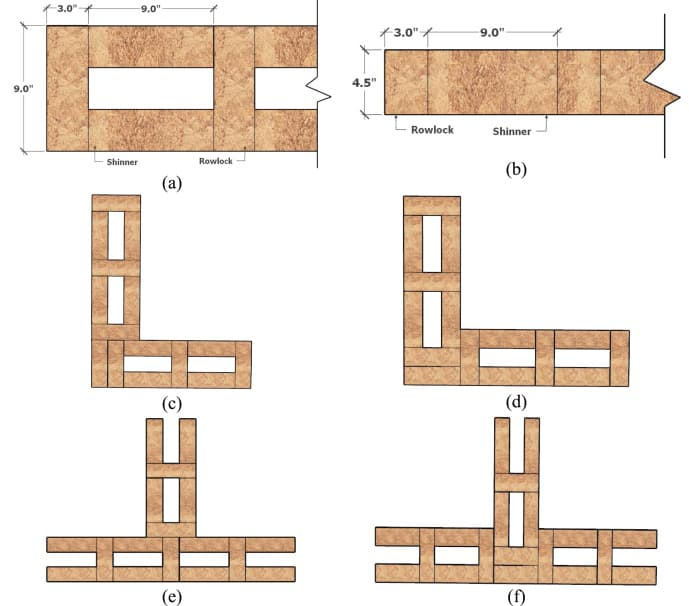
Rat Trap Bond Plan
Advantages of Rat Trap Bond
Here, the list of Rat Trap Bond Advantages are as follows.
- Requires approximately 25% less bricks and 40% less mortar than traditional masonry.
- Reduced material requirement results in considerable cost saving.
- Strength of wall is not compromised, it remains same as traditional masonry wall
Rat Trap Bond Brickwork
Rat trap bond is a brick masonry method of wall construction, in which bricks are placed in vertical position instead of conventional horizontal position and thus creating a cavity (hollow space) within the wall.
Rat Trap Bond Uses
Strength of wall is not compromised, it remains same as traditional masonry wall. Cavity induced in wall provides better thermal insulation, resulting in cooler interiors during summer and warmer interiors during winter.
Rat Trap Bond Elevation

Rat Bond Brickwork
Rat trap bond may be defined as the type of modular masonry in which the bricks are placed in a vertical position such that a cavity is formed in the wall while the thickness is maintained the same as that of the conventional brick wall masonry.
Rat Trap Bond Construction
The rat trap bond construction is a modular type of masonry construction. In this type of brick, masonry bricks are placed on edges making visible the shinner and rowlock.
Thus 110 mm face is exposed from front elevation (for brick size of 230mmx110mmx75mm). This gives the wall an internal cavity that provides effective thermal insulation.
Rat Trap Construction
Rat trap bond is a modular type of masonry bond in which the bricks are placed in a vertical position which creates a cavity in the wall while maintaining the same wall thickness as that of the conventional brick masonry wall. It is also known as a Chinese brick bond.
Rat Trap Bond Disadvantages
- It does not provide good sound insulation.
- Extra care must be taken while designing the wall length and heights for a structure.
- It requires trained masons, otherwise wastage of mortar falling into the cavity.
Rat Trap Bond Houses
The older rat trap bond houses dating from the 1930s mostly are I suppose 9″ construction without timber sub walls. It gets really hot in summer and equally cold in the winter. 0 or even -degrees Farenheight is not unknown here and it routinely gets over 100 in the summer but as we are up in the mountains it cools down quickly in the evenings.
Rat Trap Brick Wall
On average a rat trap brick wall needs cleanness of external surface (if not plastered) every three years.
Rat Trap Bond in Brick Masonry
Rat trap bond is a brick masonry method of wall construction, in which bricks are placed in vertical position instead of conventional horizontal position and thus creating a cavity (hollow space) within the wall.
Rat Trap Bond Brick Size
The bricks are placed in vertical position, so that 110 mm face is seen from front elevation, instead of the 75mm face (considering brick of standard size 230 X 110 X 75 mm). Since width of wall remains 230mm, an internal cavity is created.
]]>