What is Lightweight Concrete
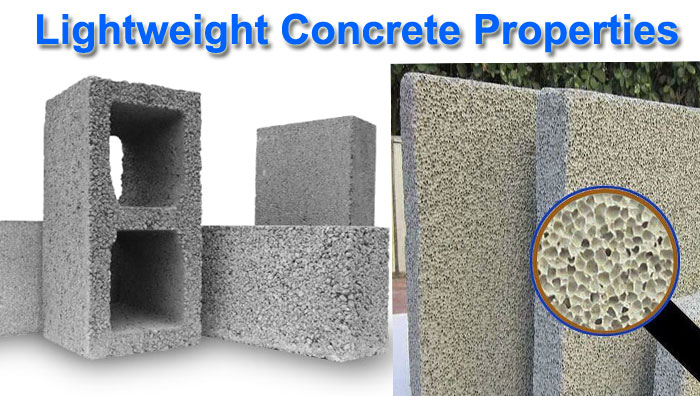
Lightweight concrete is a form of concrete that contains an expansion agent, which increases the volume of the mixture while also improving properties like inability and lowering the dead weight. Lightweight concrete’s key advantages are its low density and thermal conductivity.
Lightweight aggregates or low-density materials such as volcanic pumice, clay, slate, shale, scoria, tuff, and pellite are used to make lightweight aggregate concrete.
When compared to normal concrete, which has a density of 2300-2400 kg/m3, lightweight aggregate concrete has a density of less than 2200 kg/m3 and a fraction of the aggregate has a density of less than 2000 kg/m3.
The density of solid concrete is 150 pounds per cubic foot.
Due to the inclusion of larger particles in the natural condition, conventional concrete might weigh between 140 and 150 lbs/ft3.
Uses of Lightweight Concrete:
Screeds and thickening are made with it. When the floor or roofs need thickening or smoothing, it can be utilised to quickly do it.
It can be applied to screeds and walls where the wood will be nailed together.
Casting structural steel in lightweight aggregate concrete can protect it from fire and corrosion. It can also be used to cover architectural needs.
It can be used on roofs as a thermal insulation material.
Water pipelines can be insulated with it.
In frame constructions, lightweight aggregate concrete can be utilised to build partition walls and panel walls.
It can be used to make conventional wall insulation.
It’s also utilised to get outside walls of tiny dwellings surface rendered.
It’s suitable for usage in reinforced concrete.
Lightweight Concrete Density:
The fresh density of Lightweight Concrete on the construction site is a function of a proportionate blend of air content, water retention, particle density, and wetness.
The ACI 213 structural grade Lightweight Concrete specification says that the equilibrium dry density of Lightweight Concrete is between 90 and 115 lb/ft3.
Lightweight Concrete of good quality absorbs extremely little water, according to studies, and hence preserves its low density.
What is Lightweight Concrete | Uses, Properties, Density, Advantages, Disadvantages
What is Lightweight Concrete
Lightweight concrete is a form of concrete that contains an expansion agent, which increases the volume of the mixture while also improving properties like inability and lowering the dead weight. Lightweight concrete’s key advantages are its low density and thermal conductivity.
Lightweight aggregates or low-density materials such as volcanic pumice, clay, slate, shale, scoria, tuff, and pellite are used to make lightweight aggregate concrete.
When compared to normal concrete, which has a density of 2300-2400 kg/m3, lightweight aggregate concrete has a density of less than 2200 kg/m3 and a fraction of the aggregate has a density of less than 2000 kg/m3.
The density of solid concrete is 150 pounds per cubic foot.
Due to the inclusion of larger particles in the natural condition, conventional concrete might weigh between 140 and 150 lbs/ft3.
Uses of Lightweight Concrete:
Screeds and thickening are made with it. When the floor or roofs need thickening or smoothing, it can be utilised to quickly do it.
It can be applied to screeds and walls where the wood will be nailed together.
Casting structural steel in lightweight aggregate concrete can protect it from fire and corrosion. It can also be used to cover architectural needs.
It can be used on roofs as a thermal insulation material.
Water pipelines can be insulated with it.
In frame constructions, lightweight aggregate concrete can be utilised to build partition walls and panel walls.
It can be used to make conventional wall insulation.
It’s also utilised to get outside walls of tiny dwellings surface rendered.
It’s suitable for usage in reinforced concrete.
Lightweight Concrete Density:
The fresh density of Lightweight Concrete on the construction site is a function of a proportionate blend of air content, water retention, particle density, and wetness.
The ACI 213 structural grade Lightweight Concrete specification says that the equilibrium dry density of Lightweight Concrete is between 90 and 115 lb/ft3.
Lightweight Concrete of good quality absorbs extremely little water, according to studies, and hence preserves its low density.
Lightweight Concrete Properties
The cubical, rounded, angular, or irregular shape of the aggregates used in Lightweight Concrete is possible.
Lightweight Concrete textures can range from very thin pores, smooth skins, and huge exposed pores to very uneven surfaces with enormous exposed pores.
The workability, coarse-to-fine aggregate ratio, cement content needs, and water demand in concrete mixtures are all affected by the form and texture of the particles in Lightweight Concrete.
Compressive strength levels of roughly 3,000 to 5,000 psi are usually required by the building site for designing cast-in-place, precast, or prestressed concrete, which can be easily obtained with Lightweight Concrete.
Light-weight concrete had a much lower permeability, which was often equivalent to or lower than that of standard-weight concrete.
To achieve internal curing in Lightweight Concrete containing a high volume of cementitious materials, high-saturation aggregates can be replaced with standard weight aggregates.
Lightweight Concrete Advantages:
- Reduces the dead load of the building.
- Easy to handle and hence reduces the cost of transportation and handling.
- Improves workability.
- Relatively low thermal conductivity
- Comparatively more durable
- Good resistance to freezing & thawing action when compared to conventional concrete.
Lightweight Concrete Disadvantages:
- Very sensitive to water content in the mixture.
- Difficult to place and finish because of the porosity and angularity of the aggregate. In some mixes, the cement mortar may separate the aggregate and float towards the surface.
- Mixing time is longer than conventional concrete to assure proper mixing.
- Lightweight concrete is porous and shows poor resistance