What is Foundation Drainage?
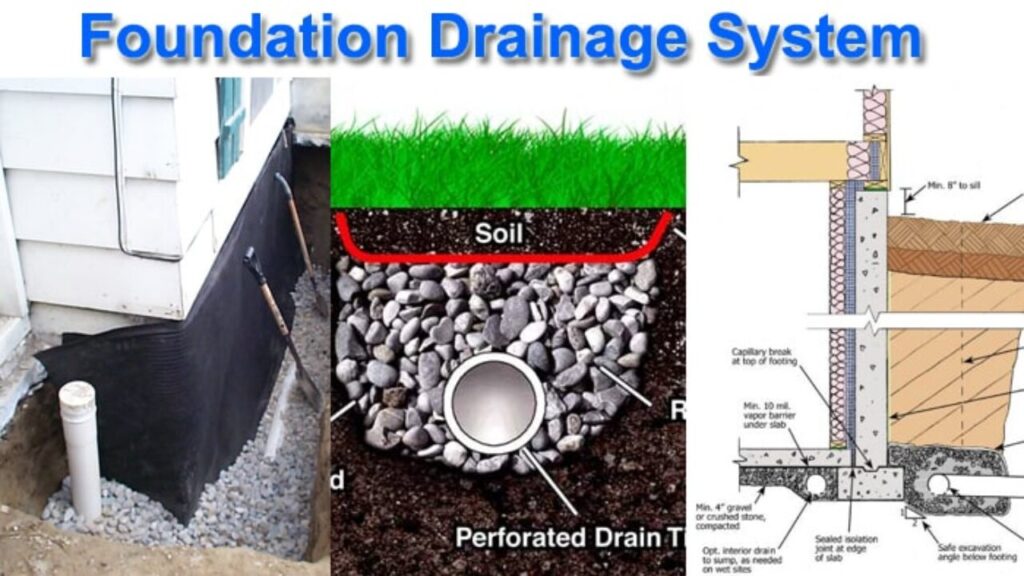
Foundation drains are pipes put beneath your foundation or basement floor to collect water and transport it away from your home, preventing your basement from flooding.
If your house was built after 1920, foundation drains are a network of pipes beneath the basement floor that is supposed to catch groundwater before it seeps into your basement. If your house was built before 1954 (approximate year), your foundation drain is most likely immediately connected to the sanitary sewer near your floor drain via a palmer valve.
A foundation drain is a gravel-covered exterior drainage system constructed on the outer face of the foundation wall and near the wall footing for the purpose of draining excess water seeping into the foundation.
Types of Foundation Drainage:
French Drain:
A “French Drain” is an underground outdoor drain line designed to convey water away from a building and into a drywell or catch basin. Our diagram depicts how water is removed from roof runoff that flows down a gutter.
Footing Drain:
A footing drain is an exterior foundation drainage system that is installed outside the foundation wall near the wall footing, covered with gravel at the level we show, and if the footing drain is going to do anything, it is piped to daylight or to a catch basin, which is then pumped to daylight or to a storm drain.
Components of Foundation Drainage System Include Following:
Gutters and downspouts are well-maintained and directed below the soil surface.
Trees must be kept at a safe distance from the building or foundation (should not be closer to the structure than their mature height)
Moisture consistency in the soil (ensure that water can drain from the soil and be replenished effectively).
Drainage of surface water (ground should have a minimum slope of 3 percent to move water away from the foundation wall).
Drains in channels (to trap water and direct it away from the foundation).
Drainage boards for the foundation (installed on the outside of concrete walls to direct water to the drain tile, used in conjunction with waterproofing membranes).
Rigid drain tile is used for subsurface drainage (either connected to a sump pump system or directed to daylight exposure).
Drain pipes go alongside the footing of the foundation.
Building codes are followed (international code requires drain pipe for most structures with concrete or masonry below grade).
Synthetic materials and geotextiles (many modern drainage systems now incorporate these materials to prevent fine soil particles from passing through and clogging drain pipes).
Advantages of Foundation Drainage:
It decreases the risk of settling by preventing water collection near the foundation. Stagnant water can also boost mosquito breeding and cause plant deterioration.
Installing a foundation drain can help to prevent soil erosion.
Draining water properly can aid in the removal of toxic and harmful organisms from stagnant water.
Disadvantages of Foundation Drainage:
A drainage system is an expensive investment. It necessitates the use of competent and professional labour.
Because of the deposition of silt in the pipe, the perforated pipe has the disadvantage of becoming clogged on a frequent basis. As a result, foundation drain maintenance is time-consuming.
Contamination of water bodies – According to the study, nitrate can be carried by subsurface drainage systems through drain pipes and straight into bodies of water such as streams, rivers, and lakes.
]]>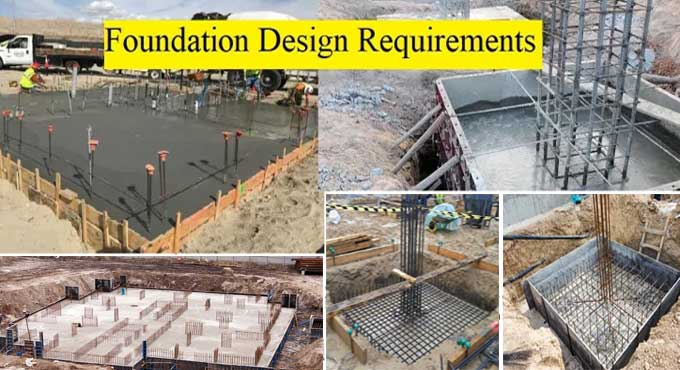
There is a point a suitable foundation is utilized like both an engineering terminology as well as a saying: it’s required for a strong structure.
Deprived of it, the structure can fall under its self-weight, be tremendously dangerous in the time of an earthquake, or basically disintegrate once as constructed.
Foundations are essential for buildings, as well as a robust foundation is a suitable step to achieve the purpose.
On the other end, it is not anywhere near simple to reach this level or point. Furthermore, in Utah, for instance, foundation crack repair services specified that certain buildings even do not obey that code.
Moreover, high-rise buildings in San Francisco sometimes begin coming across structural issues due to substandard foundation building, as well as low cost housing projects in Florida experience foundation sinking.
Therefore, how correctly can one construct a structure that is going to last for a long time? One suitable foundation should obey various fundamentals.
Permanence
It is vital for foundations (as well as the building itself) to be positioned in a region in a manner that it won’t be impacted by prospect construction projects or work. That is because of the actuality that some damage or shift in the soil nearby the foundation can deteriorate the structure as well as make it quite ineffective at shifting loads out of the building to the ground or land.
Stability as well as Cohesion
The foundation should be capable of shifting the building load to the ground devoid of warping or breakage under the strain. Furthermore, the building must not be impacted by settlement or different type of stability problem as time goes by. That permits a far more firm structure that can endure the real or natural modifications of shifting ground.
Depth
A meticulous study of the soil as well as adjoining region must at all times find out the depth of the building foundation with the aim of the structure to endure stress or shocks. Those comprise soil expansion, natural occurrence, as well as building shrinkage because of periodic variations. Furthermore, depth even permits taller as well as bigger structures to be constructed, letting them to endure different elements, like gravity as well as wind.
Consistency
Lastly, foundations should have a firm base so as to completely uphold or support the whole weight of the building. Furthermore, superimposed loads can result in buildings to drop in case the foundation is not constructed with a steady base with respect to support, creating the building tilt or slant; hence, undermining its interior structure.
Uniting those aspects entirely is the fundamentals of constructing a foundation that can assist the building as well as its occupants for a very long time.
Furthermore, it is an arrangement of town planning, urbanization as well as ordinance work, as well as little research so as to avert critical issues that can occur in the long term.
In case one is looking for working on the building foundation or one thinks certain repairs needed to be done to increase the structural stability of the building, it is optimum to discuss the professionals.
Furthermore, repairs as well as foundation laying can sometimes be quite costly as well as necessitate proficiencies as well as equipment that maximum people don’t have. Proficient foundation contractors have the entire required expertise, tools as well as means to carry out the job brilliantly. Also, they can offer frequent maintenance checks to make sure that the foundation of building remains durable.
]]>
Foundation
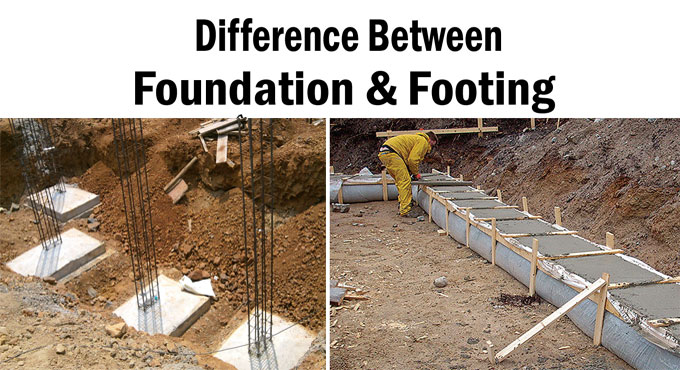
In Civil Engineering, a foundation is the lower portion of a building structure that transfers the building’s gravity load into the earth. A strong foundation is required in order for a building to stand the test of time and survive for decades or even centuries.
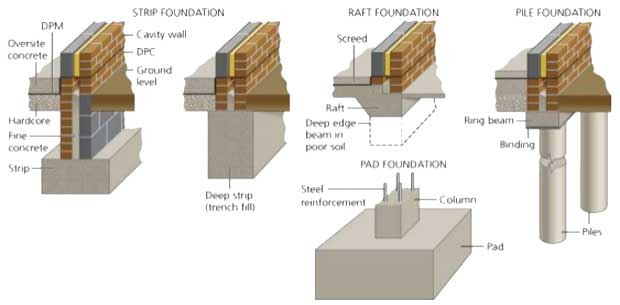
Foundations are commonly separated into two distinct categories: shallow foundations and deep foundations.
A building’s foundation is made by first digging a trench into the ground. Dig deep enough to reach the subsoil. Subsoil is more solid than topsoil, which is where plant roots grow.
Concrete is then poured into the trench, supported and strengthened further with steel rods. When the concrete dries, the steel holds it all together.
This is known as reinforced concrete, and once it is in place, the structure can be built on top.
Footing
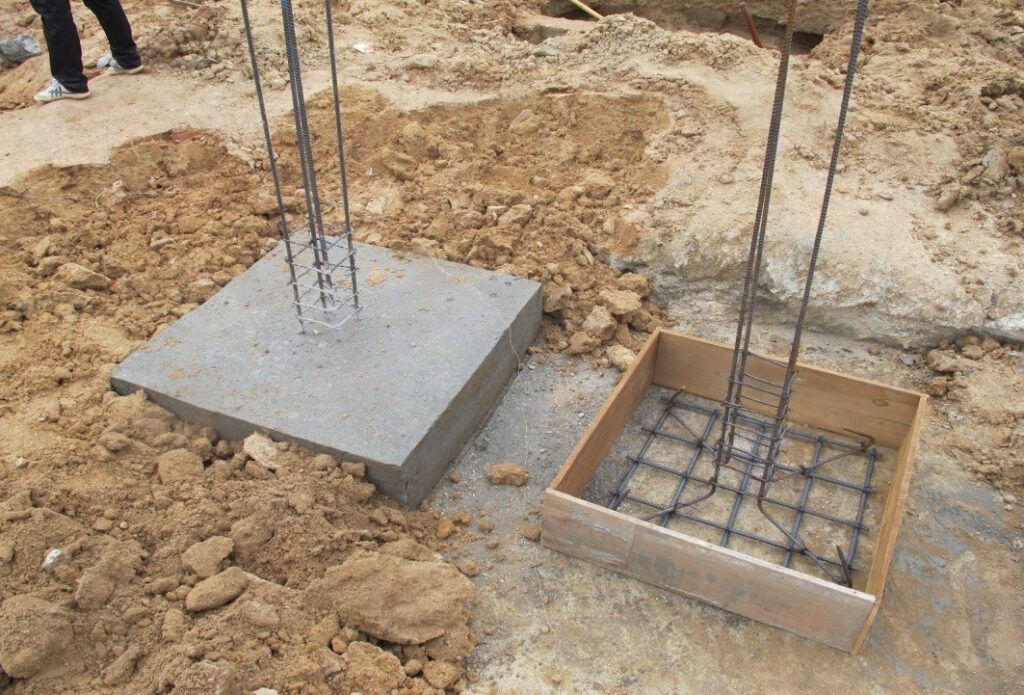
In Civil Engineering, a footing is a foundation that is constructed under the base of a wall or a column.
The purpose of the footing is to distribute the weight of the building over a large area. The term footing is generally used in conjunction with shallow foundations, not deep foundations.
or
Foundation
- A foundation is the lower portion of a building structure that transfers the building load into the earth.
- A strong foundation is required in order for a building to stand the test of time and survive for decades or even centuries.
- Foundations are commonly separated into two categories:
- Shallow foundations
- Deep foundations
- Building foundation is made by first digging a trench into the ground. Dig deep enough to reach the subsoil.
- Concrete is then poured into the trench, supported and strengthened further with steel rods. When the concrete dries the steel holds it all together.
- This is a reinforced concrete and once it is in place, the structure can be built on top.
- Footing includes slab, rebar which are fabricated of brickwork, masonry or concrete.
- Footing reinforces support to an individual column.
Footing
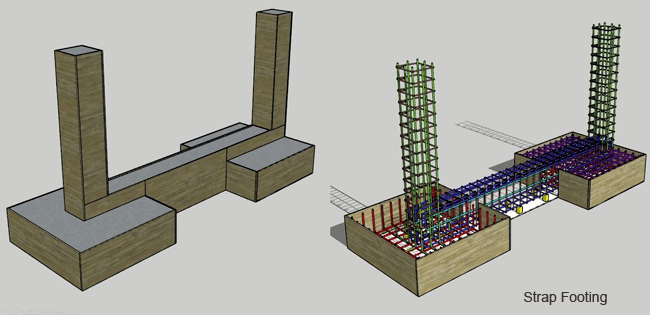
- A footing is a foundation that is constructed under the base of a wall or a column.
- Purpose of the footing is to distribute the weight of the building over a large area. The term footing is generally used in conjunction with shallow foundations not deep foundations.
- Footing is placed directly below the lowest part of the structure it supports.
- Foundation types include piles, caissons, footings, piers the lateral supports and anchors.
- Foundation is an extensive support because it gives support to a group of footings as an entire building.