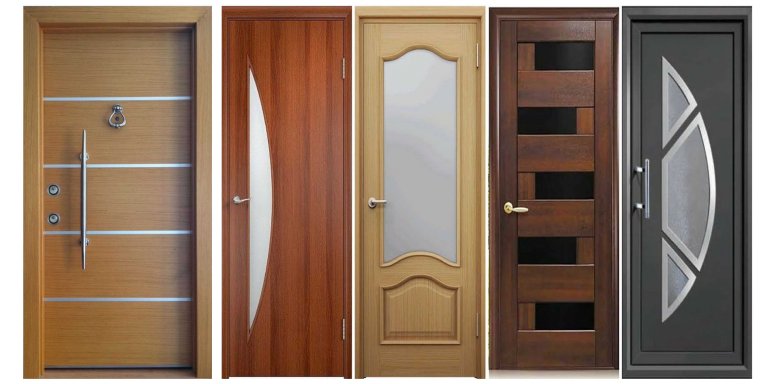
1. Introduction
The door may be defined as a framework of wood, steel, aluminum, glass, or a combination of these materials secured in an opening left in a wall for the aim of giving access to the uses of the structures.
| Types of buildings | Size of the door in mm |
| 1. The door of Residential Building(a) External Door(b) Internal Door(c) Door for Bath or W.C. | 1000×2000900×2000800×2000 |
| 2. Doors of Public Buildings such as School Hospital Library etc. | 1200×20001200×2100 Or1200×2250 |
| 3. Doors of Garage | 2250×2250 |
2. Parts of a Door
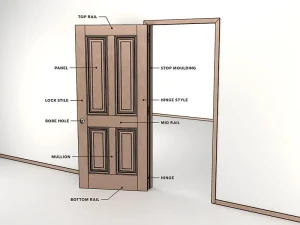
Here is a list of parts of a door usually seen in the community:
1. Top Rail
2. Panel
3. Stop Moulding
4. Mid Rail
5. Bottom Rail
6. Hinge
7. Mullion
8. Hinge style
9. Borehole
10. Lock stile
Panel
A door panel, many times called a slab, defines the whole part of the door that swings backward and forward. Full door panels are generally divided up into smaller box-like panels, which are adjusted between the stiles, rails, and mullions.
Rail
The small horizontal part on a door panel is called rails. This door has a top, bottom, and a mid-rail.
Stile
A stile is the small vertical part located on either side of a door panel. One is called the lock stile and the other is known as a hinge stile.
Mullion
A mullion looks like a stile. It is the vertical part that distinguishes two panels located in the middle of the door between the rails.
Stop molding
Doorstop molding is joined to a door frame. It limits the door panel within the frame and saves the panel from moving right through the opening.
Hinge
This is the part of the hardware that permits the door to swing open and closed. Standard-sized doors contain three hinges, but in larger doors, there will contain four or more. The color or finish of the hinges looks like the finish of the lockset.
Borehole
A borehole is drilled into a door to put up a lockset.
Lockset
The lockset defines the handles, locks, latches, strike plates, and all the other hardware parts that permit a door to catch and lock in place. Locksets are also defined as handsets or hardware.
Head Or Header
The components of the door at the top of the door that is many times called the “top jamb” which is incorrect. It is properly known as the “head” or the “header”.
It works similarly to the jambs in that it forms a component of the door frame. It is on the top and not the side, it shouldn’t be known as a jamb.
source: dreamcivil.com
Doorframe / Casing
The doorframe is known as the two jambs and the header together. This is the component of the door that is attached to the rough opening when mounting a door. In another way, we can say the doorframe is “casing”.
Rough Opening
The rough opening is the opening in the wall that supports the doorframe. The doorframe is attached to the rough opening with the help of shims, tiny pieces of wood that are crushed between the sides of the rough opening, and the doorframe to support it in place.
Latch
The latch is the component that supports the door closed. When you turn the doorknob or push the handle down, the operation causes the latch to be pulled into the door, permitting the door to open.
Keyhole
A keyhole is a place where you insert the key to lock or unlock the door.
Sidelight
A sidelight is a small window placed on either side of a door. They are only found with external doors only.
3. Use of Doors
a. Doors give connecting links between the different internal rooms of the house.
b. It provides an aesthetic beauty of the house.
c. Open door gives lighting and ventilation to different rooms in the house.
d. It commands the physical atmosphere within a space by surrounding it, except air drafts so that interiors may be more successfully heated or cooled.
e. It also works as a noise barrier if there are high chances of too much noise outside of the house.
f. It is utilized to screen areas of a house for aesthetic use, keeping formal & utility areas different.
4. Advantages of Doors
1. It’s a great way to create privacy.
2. It provides security.
3. It helps to pass light, the air inside the house.
4. It adds aesthetic beauty.
5. It sometimes acts as a noise barrier.
5. Disadvantages of Doors
1. Door openings might be risky of building failure during an earthquake.
2. It needs regular maintenance and care.
3. Timber doors are costly and can catch fire easily
]]>