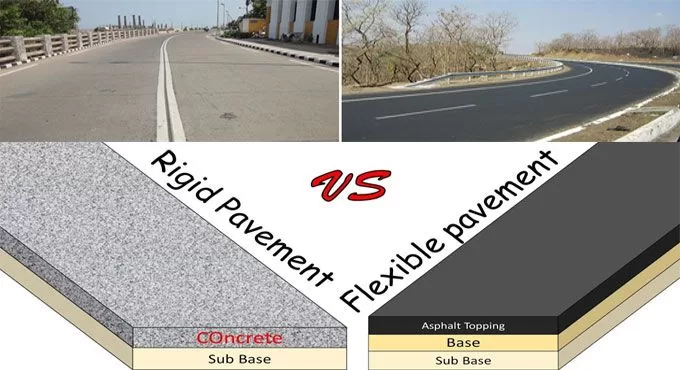
Flexible and rigid pavements are the two most common types of roadways constructed for transportation purposes. Flexible and rigid pavements both of these types of pavements are designed for specific and needful purposes. Each one of them has their own advantages and disadvantages.
In this article, we will explore the major differences that can be found between flexible and rigid pavements
Flexible Pavements
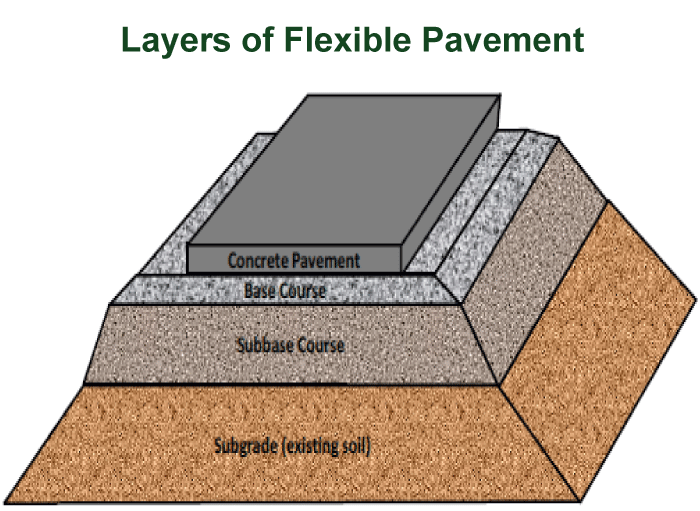
Flexible pavement is the most common type of pavement used for roadways and highways.
As the name suggests, these pavements are flexible in nature and can bend and deform under the weight of traffic found on a regular basis.
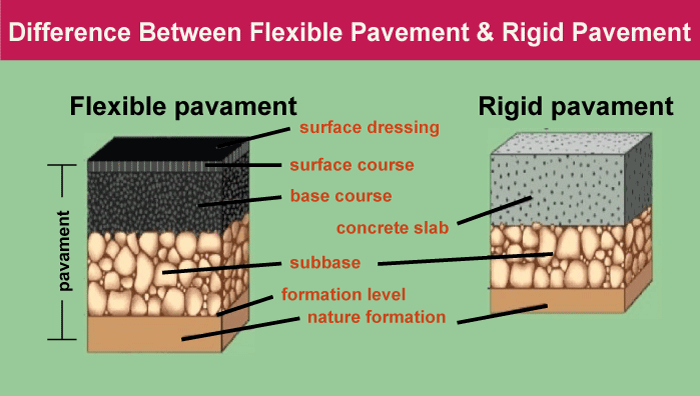
They are made up of several material layers, including the surface layer, base layer, sub-base layer, and sub-grade. Each layer is designed to provide a specific purpose and performs a specific function. And the overall pavement structure is designed to distribute the traffic load evenly across the layers to prevent any deconstruction.
Different Layers Used in The Flexible Pavement
- Number one is the surface layer. The surface layer of a flexible pavement is usually made up of concrete. It is designed to provide a smooth riding surface for every vehicle, whether it is a light or heavy vehicle.
- The second layer is the base layer, typically made up of crushed stone or gravel; this is specifically designed to provide support and stability to the surface layer.
- The third layer is the sub-base layer. This layer is typically made up of compacted soil or gravel and is designed to provide additional support to the base layer.
- The fourth layer is the sub grade layer, which is made up of natural soil or raw, and the pavement is built above this layer.
Advantages of Flexible Pavements
One of the major advantages of flexible pavement is that they are relatively easy and are budget friendly to construct.
- Flexible pavements can be built quickly and do not require a lot of heavy pieces of equipment.
- They also have a higher degree of flexibility, making them stand temperature changes and minor ground movements without breaking.
Disadvantages of Flexible Pavements
Flexible pavements have certain disadvantages as well, and among them are-
Flexible pavement is less durable than rigid pavement and requires more maintenance.
They usually tend to deteriorate more quickly in areas with heavy traffic or harsh weather conditions.
Rigid Pavements
Reject pavement is usually made up of a single layer of concrete that is designed specifically to provide a strong and rigid service for vehicles so that they can have a smooth journey. They support each and every type of vehicle, either it be a light one or a heavy one.
Rigid pavements are usually used for high-traffic areas like airports, industrial parks, and interstates. Rigid pavements are specifically designed to distribute a load of traffic across the entire surface of the pavement, which eventually leads to reducing the stress on individual section of the pavement.
Advantages Of Rigid Pavements
One of the major advantages that we can figure out in rigid pavements is that they are very durable, can last for a long time, and does not require much maintenance.
Rigid pavements can be seen as a very strong construction method, and can easily support heavy loads without deforming or leading to any deconstruction.
In addition to the advantages mentioned above, we can also see one of the major advantages that rigid pavements serve, which is that they are resistant to damage from temperature changes, moisture, and chemicals and stay strong even in the harsh weather conditions.
Disadvantages Of Rigid Pavements
We can see that rigid pavements are more expensive and time-consuming to construct than flexible pavements, requiring specialized equipment and well-knowledgeable labor.
Rigid pavement is less flexible as compared to the flexible pavement and can be prone to cracking in areas that have significant ground movement.
Factors To Consider While Choosing Flexible Pavements or Rigid Pavements
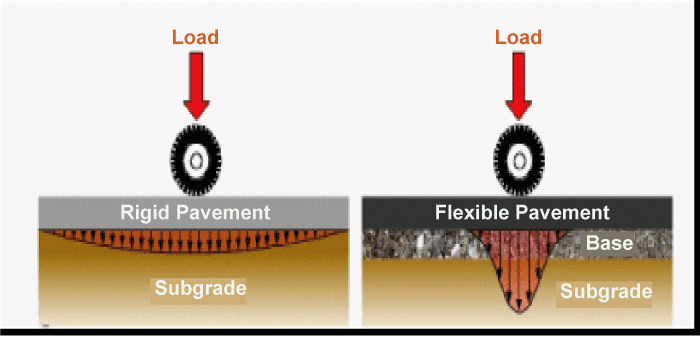
Whenever someone wants to construct a road highway or the airport runways, there are only 2 types of pavements available that are rigid and flexible pavements. Both types of pavements have their own advantages and disadvantages, and the decision to choose one over the other completely depends on the various factors that we will discuss further.
First, let us talk about who should go for flexible pavement.
Flexible pavement comprises multiple layers of aggregate material that can adjust to traffic movement. The soil present below this type of pavement is better-suitable for areas with low to moderate traffic volumes and areas with fluctuating temperatures.
Flexible pavement is also a cost-effective method, and the best solution for short to medium-length roads, driveways, and parking lots.
Here are some factors that will help you determine that whether you should go for flexible pavement or not for your project
1. Low To Moderate Traffic Volume
If your roadway or driveway does not experience high-level of traffic, then you should definitely go for flexible pavement. The primary reason behind this is that the asphalt surface can easily accommodate the weight of the vehicle and adjust to choose changes in the soil and temperature.
Additionally, the construction cost of flexible pavement is quite less as compared to rigid pavement, which makes it more cost-effective for constructors or architectures that have to go for smaller projects
2. Varied Weather Conditions
Flexible pavement is a better option for areas that experience fluctuate fluctuating temperatures and often have different weather conditions. The key reason behind this is the asphalt layer can expand and contract with temperature, which helps to prevent cracks and deconstruction. This is especially important in areas that face harsh winters with temperature swings that can cause significant damage to the rigid pavement
3. The Type of Soil
Flexible pavements are the best option for those areas that have less stable soil. The reason behind this is that the flexible pavement design allows the soil to move and adjust, reducing the risk of any cracks. This can be especially important in areas that have expansive soils, which can cause significant damage to the rigid pavements.
Now let us talk about Rigid Pavements
Rigid pavement is made up of a concrete slab that is reinforced with steel or other materials, that completely depends upon the requirement. Rigid pavement is better suited for areas that experience heavy traffic volumes and have a consistent weather condition. It is more durable and long lasting as compared to flexible pavement, which makes it a good option for high-traffic areas like airports, and highways.
Here are some factors that can help you determine if rigid pavement is the right choice for your project or you should consider another method of pavement
1. Heavy Traffic Volume
If you have a knowledge about the traffic that your area might face, if your road or highway experience heavy traffic volume, rigid pavement option is the best choice for you. The main reason behind this is that the concrete surface can withstand the weight of a heavy vehicle without leading to any breakage or cracks. Secondly, the smooth surface of the concrete provides a comfortable ride for drivers and reduces the risk of vehicle being teared.
2. Consistent Weather Conditions
Rigid pavement is a better option for areas that have consistent weather conditions, like areas with stable climate or those with limited temperature swings. The sole reason behind this is that the concrete that is used to make the rigid pavement is more suspect-able to damage that is caused by temperature changes
3. Longevity
It has been seen that rigid pavement is more durable and long-lasting as compared to flexible pavement. This is because the concrete slab can withstand heavy traffic volumes and does not require much maintenance. Because of this, it is a good option for areas that require long-lasting pavement solutions, such as airports, ports, and highways.
Overall, we can say that the decision to choose flexible or rigid pavement completely depends upon the requirement of the client and also on the factors like traffic volume, weather conditions, soil type, and length of the project. For smaller projects that have low to moderate traffic volumes fluctuating temperatures, and an unsuitable soil for these the flexible pavement is the best option.
Whereas for larger projects with heavy traffic volumes, consistent weather conditions, and the need for durability and longevity, rigid pavement option is the best option. Ultimately, the choice between flexible and rigid pavement will depend on the specific needs of your project. It is important to consider your budget and other conditions as well while going for rigid or flexible pavement
| Criteria | Flexible pavement | Rigid pavement |
|---|---|---|
| Material used | Flexible pavements are made up of asphalt and aggregate materials. | Rigid pavements are made up of concrete that is in forced with steel or other hard material. |
| Traffic volume | Flexible payment are best suited for areas That have low to moderate traffic volume. | Rigid pavement are best suited for areas that have heavy traffic volume. |
| Weather conditions | Flexible pavement are best suited for areas that have varied weather conditions or face fluctuating temperatures. | Rigid pavements are better suited for areas that have consistent weather conditions. |
| Soil type | Flexible pavement can last long on less stable soil. | Rigid pavements can last long on in stables soil. |
| Durability | Flexible pavement are less durable and require more maintenance. | Rigid payment are more durable and required less maintenance. |
| Construction cost | Construction cost Flexible pavement have lower initial construction cost. | Rigid pavement have higher initial construction cost. |
| Longevity | Flexible pavement have shorter life span | Rigid pavement have a good longer life span. |
| Comfort | Flexible pavement is known for providing a comfortable right for the drivers. | Rigid pavement provides a comfortable right for the drivers. |
| Smoothness | Flexible pavement have a lighter suffer surface. | Rigid pavement have a smooth surface. |
| Expansion and contraction | Flexible pavement can adjust to the changes in the temperature and soil movement. | Rigid pavement or less flexible and more suspect-able to damage from temperature changes. |
Difference Between Flexible and Rigid Pavements
1. Material Used
In case of flexible pavements, they are composed of layers of asphalt and aggregate materials. This design allows the pavement to adjust to the movement of traffic and changes in the underlying soil full on the other hand, rigid pavement consists of a concrete slab that is reinforced with steel or other strong materials. This design provides a more durable surface that is less suspectable to cracks or any other form of deconstruction.
2. Traffic Volume
One of the vital factor that you have to consider while deciding between flexible pavement and rigid pavement is the traffic volume flexible pavement are well suited for areas that have low to moderate traffic volumes.
The key reason behind this is that the material that is used to make the flexible pavement that is asphalt, this surface can accommodate the weight of vehicles and adjust to changes in the soil and in the temperature as well.
On the other hand, in rigid pavement, the construction is made up of concrete surface, which is eventually better suited for areas that have heavy traffic volume. The main reason behind this is that the concrete surface can withstand the weight of heavy vehicles without leading to any cracks or any other form of deconstruction
3. Weather Conditions
Another major factor that you have to consider while choosing between flexible and rigid pavement is the weather. In case of flexible pavements, they are better suited for areas that face fluctuating temperatures and have vulnerable changing weather conditions.
The reason behind this is that the asphalt layer can expand and contract with the changing weather conditions, which eventually helps to prevent cracks or any other form of deconstruction. This is vital in areas with harsh winters with temperature swings that can cause a sufficient amount of damage.
On the other hand, rigid pavements are better suited for areas with consistent weather conditions, such as areas with stable climate or those with limited temperature swings, for example, Bengaluru. This is because concrete is less flexible than asphalt and is more suspectable to damage from temperature changes
4. Soil Type
Another major factor that you have to consider while choosing between flexible and rigid pavement is the type of soil that is present in the area. Flexible pavements are better suited for areas that have less stable soil.
The reason behind this is that the flexible design of the pavement allows the soil to move and adjust according to the traffic, which eventually reduces the risk of damage or cracking. This can be especially important in areas that have expansive soils, which can cause significant damage to rigid pavements.
5. Durability
Durability is another important consideration that you have to look while you are selecting between flexible and rigid pavements. Rigid pavements are generally more durable and long lasting as comparative to flexible pavements, and the reason behind this is the concrete slab that can withstand heavy traffic volumes and does not require much maintenance.
On the other hand, flexible pavements require maintenance and have a shorter lifespan. This makes them a good option for smaller projects that have low traffic volumes and shorter life spans.
6. Construction Cost
Construction cost is one of the major factors that you have to look at while selecting between flexible and rigid pavements, but you also have to consider the purpose of your project.
Generally, flexible pavements are less expensive to construct than rigid pavements, and the reason behind this is that the material used to make the flexible pavement is less expensive than the material used to make rigid pavement. Secondly, flexible pavements are easier to install, which can also reduce labor costs.
However, it is vital to note that the long-term cost of ownership for rigid pavements is often lower due to their long-lasting life span.
7. Longevity
The life span of a pavement is an important consideration when you are deciding between flexible and rigid pavements. Rigid pavements generally have a longer life span compared to flexible pavements. The reason behind this is the concrete slab that can withstand heavy traffic volumes and does not require as much maintenance as flexible pavements. Secondly, it is important to note that digit pavements can be more easily repaired as compared to flexible pavements, which can extend their life span even further.
8. Comfort
The comfort of drivers and passengers is one of the most vital factors you must consider while selecting between flexible and rigid pavements; as usual, pavements generally provide a smoother, more comfortable ride compared to flexible pavements, the drivers prefer to go for rigid pavements. The sole reason behind the smoothness of rigid pavements is the concrete surface that leads to smoother and less prone to bumps and dips areas.
Conclusion
To summarize the above discussion of differences between flexible and rigid pavements, the decision to choose between the 2 is only sometimes straightforward and requires careful consideration of various factors. The choice of a pavement depends on various factors, including traffic volume, weather conditions, soil type, durability, construction cost, and longevity. Both types of payments offer different types of benefits and have unique characteristics that make them well-suited for specific conditions and projects.
To compose our discussion on flexible pavements, they are made up of asphalt and aggregate materials, making them well-suited for areas with low to moderate traffic volumes. They can adjust to the movement of traffic and changes in the underlining soil, making them an ideal choice for areas with less stable soil. Secondly, they are better suited to fluctuating temperatures and changing weather conditions, making them an overwhelming choice for areas with harsh winters.
On the other hand, rigid payment is made from concrete slabs reinforced with steel or other hard materials, making them a better choice for areas that face heavy traffic volumes and have consistent weather conditions. Rigid pavements have been seen that they are more durable and have a long life span as compared to flexible pavements. Secondly, they can provide passengers and drivers with a smoother and more comfortable ride.
Overall, the choice between flexible and rigid pavement is not a one size fits all solution. Each project must be evaluated individually, considering the unique needs and requirements of the area. It is crucial to thoroughly understand the benefits and drawbacks of both types of payments. The project holder needs to make an informed decision to avoid any circumstances.
If you want to go for construction, it is essential to work with a qualified pavement contractor with extensive experience in both types of pavement. Through a well-educated contractor, you can get health to evaluate the specific needs of a project. They will also recommend the most appropriate type of pavement that will make your project last long.
]]>
Post–tensioning is a method of reinforcing concrete in a slab and beam. Post-tensioning is a form of prestressing.
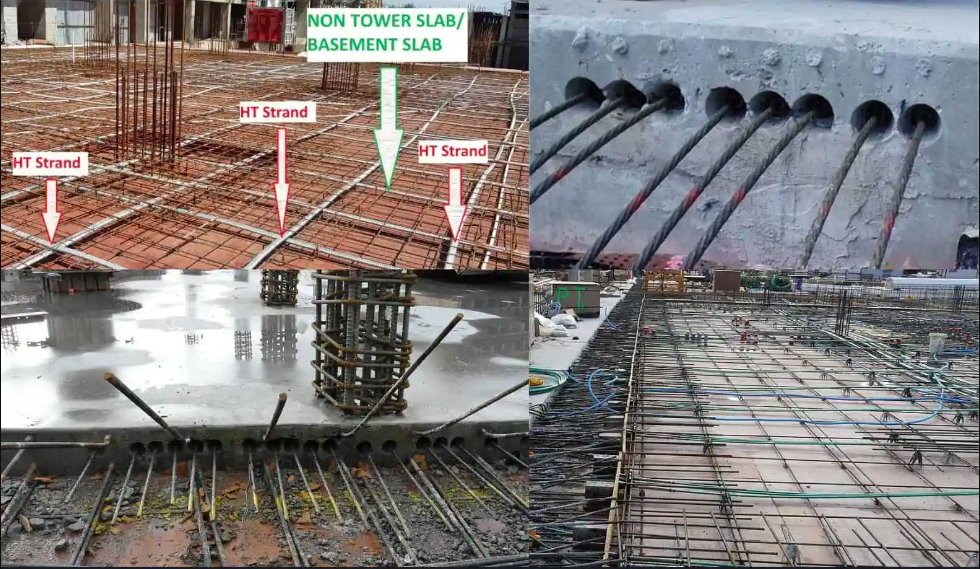
In post tension slab tendons are prestressing steel wires inside plastic ducts or sleeves or metallic sheets and it is positioned in the forms before the concrete is placed.

After this process concrete gets strength but before the service loads are applied the cables are tensioned and anchored against the external edges of the concrete slab.
What Is Post Tension Slab?
Post tension slab is a combination of conventional slab reinforcement and extra projecting high-strength steel tendons which are continually subjected to tension after the concrete has been settled down.
This method helps to achieve the formation of a thinner slab with a longer side span devoid of any column-free spaces.

Post–tensioned concrete means the concrete is filled after the tension is applied, but it is still getting stressed before the loads are applied.
The Post Tension Slab is the type of slab in which the reinforcement goes through ducts and is made of steel cables, not bars. These wires have to be made out by tensioning them after the concrete has hardened and before the scaffolding is taken away from buildings.
This means that the slab bends upward direction so all the concrete works as in compression through the slab.
The Post Tension Slab is usually called post-stressed concrete when there is pre-stressed concrete (the wires need to be tightened before pouring the concrete) and once the mixed concrete has hardened, it can be released from the wires.
The effect is also the same the slab is bending upward side by the tension and there are no sections of the slab where the concrete is pulled. It all works in compression form.
The slab with cables in the pipe is ready to be stressed. It is done after the concrete has to get hardness, so it is post-stressed.
Principal of Post-Tension Slab
Concrete has high compressive strength and steel has high tensile strength when combined it is used to bear loads, and the efficiency increases manifold.
When a heavy live load is applied to the structure its concrete slab undergoes tension form, which leads to the constitution of cracks and ultimately deformation.
To reduce this problem in the post-tension slabs, post-tensioned steel tendons are entered at the time of concreting and tensioned after concreting with conventional rebars.
Types of Post-Tension Method
Bonded Posts

Bonded Post Test
Bonded post-tension slab is used for large structural elements like beams and transfer girders. This method was used for Crete monolithic slabs for house construction where adobe clay Crete problems in the perimeter foundation.
Also used in the construction of bridges. Design advantages include increased span lengths in building and load-carrying capacity and decreased deflection. In this method, Hooke’s law was used to maintain tension and wedge position.
Unbonded Post-Tensioning

It is typically used in new construction for elevated slabs, slabs on grade beams, transfer girders, joists, shear walls, and mat foundations.
In the post-tension slab method, the tendon is coated with lithium–based grease and covered in a plastic sheet formed. Light and flexible these two are the unbounded mono strand that can be easily and rapidly installed for providing an economical solution.
Freyssinet System

It was inaugurated by the French engineer Freycinet. High-strength steel wires of 5 to 7mm diameter of 8 -12-16-24 numbers are grouped into a cable with a helical spring inside steel wires are carried along these grooves at the ends.
it is pulled by Freycinet double-acting jacks which can pull through suitable grooves for all the wires in the cable at one time.
Magnel Blaton System
It is having two wires stretched at one time. This method was introduced by the magnel of Belgium. In this method, the anchor consists sandwich plate having grooves to hold the wires.
All plates carry 8 wires. Approx 5-7mm wires are used in this method. One cable consists of 8 wires. These wires with sandwich plates are used as a tapered wedge.
Gifford Udall System
It was introduced by Great Britain, the type of system used in India. In this system single wire is used and all wires are stressed freely using the double jack.
In this system two types of anchorages are used: 1) tube anchorages and 2) plate anchorages.
Components of Post-Tension Slab

Ducts
It is placed inside the slabs to allow the tendons to pass. The main purpose of ducts is to connect cables with tendons. It is available in metal sheet ducts and plastic ducts.
It is thin sheet metal pipes with claw coupling and welded overlapped seam supplied in length of 4 to 6 meters respectively and used as standard ducts are pinned to each other by an outer screw coupling and locked with PE tape.
Plastic ducts are also available on the market to be used besides metallic ducts in post-tension slabs. Ducts are used as waterproof, frictionless, and fatigue-resistant.
Anchors
One of the most useful aspects of a post-tension slab is an anchor. It is used to bind the tendons into the concrete while deducting or joining two tendons.
The main function of anchorage is to transfer the stressing force to the concrete after the stressing process is completed. Extra reinforcement is provided along the anchors.
In some countries, the anchor is also referred to as a trumpet cone. Also used in houses grouting inlet and outlet pipes to allow grouting of the tendon duct in post tension slab.
This device used the following principal,
1) Wedge action,
2) Direct bearing
3) Looping the wires.
Strands
The steel member that is pre-stressed and embedded in concrete loses the initially given stress exponentially with time. Up to a 10% reduction in steel, requirement is possible. Also reduction in concrete requirements due to the reduced size of structural members.
Jacks
It is the most important part of PT construction. When the placing of strands and casting of concrete is successfully done after 5 to 7 days the jacks are used to give stress to these strands and pulled out to tighten these strands in concrete.
Bearing Plate
It is used to save strands from concrete and avoid casting in a post-tension slab. Provide a proper front for stretching.
The Keeper Plate/ Looping Plate
It is used to support the bearing plate.
Coupler/Barrel
It is used at the time of stretching of HT strands and connects strands or bars. This device was tested to transmit the full capacity of strands.
Vent Coupler
It is used at the corners. Used for grouting purposes at ends.
Grouting Equipment
It is the concrete filling of the duct with a strong bond between the tendons and surrounding grout.
The grouting is prepared by the water-cement ratio of about 0.5 with water-reducing admixture, expansion agents, and pozzolans.
Construction Of Post Tension Slab
The following are the steps for the construction of post tension slab,
1. Set up strands in position then set up duct in position and connect ducts with couplings. Insert strand introduces at that one time one strand. set up bar chairs at the right location given on the drawing. Tape all duct joints.
2. Now tendons are set up in the right position as given in the drawing. Set up stressing anchorage parts and stressing recess on slab edge formwork. Now install the bearing plate at the right position using a chair and also provide a grout vent. Fix out anchorage bursting reinforcement. Tape all connections carefully.

3. Prepare dead-end anchorage parts. Bulb dead-end type will be used. All strands are formed with a bulb dead end by a hydraulic jack.
4. Filling of concrete is done when MS bars and PT components are installed. Tendons need to be observed during concreting any misalignment of tendons results face failure. After concreting concrete should be cured until the specified strength not gets.
5. Now tack off side formwork and prepare for stressing operation. When stressing operation starts carefully clean up all strands. Used colar mark strand for elongation measurement.
6. Set up the anchor head and wedge it into all strands. Start pt stressing after concrete gets compressive strength. Stressing pull load on all strands should be locked off.
7. Stressing can be conducted in both ways transverse and longitudinal. Elongation should be observed.
8. The pressure did by conformation to the calibration document. After the elongation has been approved the strand should be cut using an abrasive disc.
9. Grouting performed asap after stressing operation is completed. Also, a grout vent provides an anchorage for all cables.
10. Anchorage should be capped with concrete grouting equipment have specified sprinkling pressure and material should be taken in a given proportion, not greater than a low slump level.
11. After the grouting process is done some projection surfaces are cut down by an abrasive disc.
Applications
The following are applications of the post-tension slab,
- It reduces or eliminates shrinkage cracking so no joints or fewer joints are needed.
- Cracks the form is held tightly together.
- Permission for slabs and other structural members to be thinner.
- It allows for constructing slabs on expansive or soft soils.
- It designs longer spans in elevated members like floors or beams
- In parking, slots were heavy reinforced thick concrete slabs.
- In bridge decks used slabs allows bridges to span longer lengths without the need to have extra piers or supports.
Advantages
Lower long-term costs
when maintenance requirement is less anyone can save on long-term costs. Then the customer can enjoy some energy savings and the opportunity to earn LEED credits.
Structural Durability
PT slabs show reduced cracking, improved durability, and reduced maintenance costs.
Since they won’t deflect their loading so the immediate hairline cracking is no more observed that otherwise looks odd.
Their bending can be controlled by changing the amount of post-tensioning to balance any portion of the given loads immediately after the given stress.
Fast Construction
when reducing rebar allows for saving considerable time that is otherwise taken up by rebar fixing. The same strands are true with formwork and rebar pouring.
Architectural Benefits
The pt slab has advantages over others as it makes a very efficient base for floor design with thin slabs and columnless spaces in larger spans. It gives architects the independence to work freely with the building’s slab designs.
Reduced Dead Weight
when the pt slabs have a lesser thickness, the quantity of concrete and reinforcement used in the building is reduced by up to 20 to 30% when compared to conventional concrete slabs.
Popularity
because of the benefits, the popularity of pt slabs has skyrocketed for years. The demand for PT slabs throughout all countries continues to increase because of some of the profitable benefits for developers, architects, engineers, contractors, and customers of using buildings.
Improved Performance
The pt slabs are ideal for structures where customers need improved seismic behavior, less vibration, and deflection and crack control. These are perfect for watertight and flexibility in building flooring.
Commercial Real Estate
the post-tensions results in thinner concrete slabs, making the valuable savings in floor-to-floor height available as additional floors. It can provide some extra space within the same overall building height for use as rentable.
Material Saving
while saving the PT slab using a thinner concrete slab. There is substantial material saving. These reduce overall 20% and reinforcement by as much as 75%.
Certification
There are only two groups that offer certification related to PT construction:
PT Institute
PTI has a certification license for manufacturing plants and their parts (level 1 and level 2)
Ironworkers Union
it is introduced by JimRogersand has evaluation and certification licenses also he is the publisher of PT magazine.
FAQs:
What do you mean by Post Tensioning Slab?
Post–tensioning is a method of reinforcing concrete in a slab and beam also. Post-tensioning is a form of prestressing.
What are the advantages of the Post Tension slab Method?
1. Lower long-term costs
2. Structural Durability
3. Fast Construction
4. Architectural Benefits
5. Popularity
6. Improved Performance
What is the Principle of PT Slab?
Concrete has high compressive strength and steel has high tensile strength when combined it is used to bear loads, and the efficiency increases manifold.
]]>

- Written by Eduardo Souza
- August 25, 2020
In the dome of the Pantheon in Rome, several construction techniques were used to allow such a bold construction to stand. One concerns the composition of the concrete (in this case, non-reinforced concrete) with different densities throughout the structure. Closer to the top, lighter stones were used in the mixture, reducing the dome’s weight retaining the solidity of the base.
Another technique was the inclusion of “coffers”, which are nothing more than subtractions in the concrete, reducing the weight of the dome while maintaining a cross section sufficiently robust to support its own weight. Built almost 1,900 years ago, this building still surprises us with the genius of the solutions. Using a quantity of materials just high enough to fulfill its primary function, and creating intelligent structures as a result, is just one of the lessons that this building provides.

Concrete is one of the most commonly used materials in the construction industry. However, the production process of concrete consumes large amounts of energy and non-renewable natural resources, while simultaneously emitting considerable amounts of gas that only contribute to the worsening of the planet’s greenhouse effect. Looking for ways to make its use in buildings more eco-conscious, while still taking advantage of its structural characteristics, is a first step towards the more sustainable future of civil construction.
For this reason, it is important to understand both the potential of concrete and its weaknesses. In the case of concrete slabs, a major disadvantage of the material is its considerable weight, which limits larger spans of concrete at the risk of the structure collapsing. Concrete has good resistance to compression, but very little resistance to tension. Thus, reinforced concrete uses steel to support the slab from against acting tensile forces.


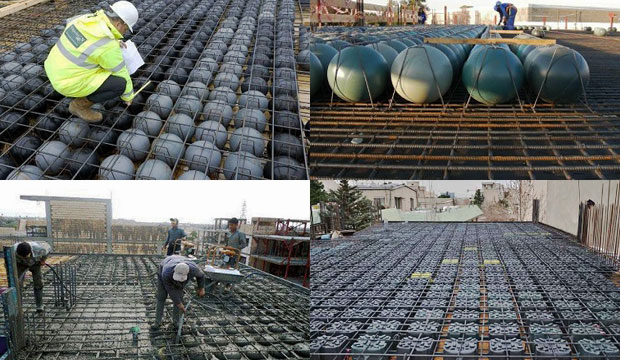
In precast, hollow, or ribbed slabs, part of the space that would otherwise be occupied by the concrete is left empty or filled with a material of less weight, such as ceramic bricks or expanded polystyrene. A similar approach was developed in the 1990s by Jorgen Bruenig, who developed in Denmark a type of biaxial hollow slab (today better known by the BubbleDeck trade name). It is a system composed of hollow spheres made of plastic, which occupy places where the concrete has a less important structural function, such as in between columns. The spheres, inserted uniformly between upper and lower steel reinforcements, fill with air the space that would otherwise be occupied by concrete serving little structural function and adding significant weight. With this system, it is possible to reduce between 25% and 35% of the slab’s own weight (compared to a solid slab of the same thickness), allowing for larger spans, reducing the section of the columns, and decreasing overload on the building’s foundations. It is estimated that the use of 1 kg of plastic for the spheres saves about 100 kg of concrete.


Also called biaxial hollow core slabs, the properties and behavior of this material are similar to that of massive concrete slabs, since the forces are transferred in both horizontal directions to the pillars and foundations. They can be built using modules, pre-slabs, or finished panels. They require less shoring than solid or even ribbed slabs, allowing the construction to move faster. Using prefabricated components can also significantly reduce the need for labor, resulting in even faster and cheaper construction.
The spheres can be composed of recycled polypropylene material or polystyrene, with low specific weight and good resistance. After the concrete is poured, the piece appears to be a traditional solid concrete slab and the spheres remain in the structure. Research and tests have demonstrated this technique’s strong acoustic quality and fire resistance as well. Evidently, however, it is a system that requires more attention to detail, particularly when designers have to adapt the existing dimensions to new design demands. Another limiting issue is that in some countries, there are still no regulations specific to this system, or enough labor with adequate experience in this method.

In recent years, this technique has been widely applied to large-scale projects, such as educational buildings and even airports, where deadlines are tight and budgets permit investing in new methods. Searching for sustainable solutions may mean creating new materials and new technologies, but it can also be as simple as using the same material in more intelligent, conscious, and efficient ways.
]]>