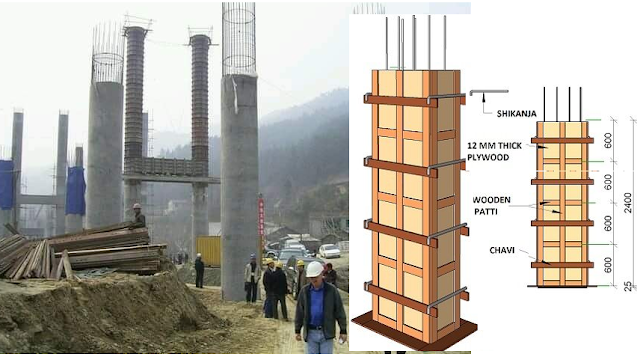
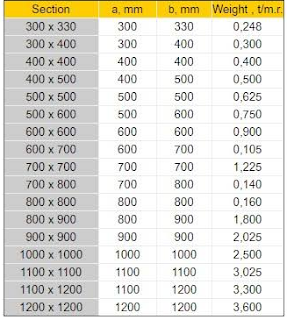
Column has not fixed size. The column’s size depends on different aspects such as loads on column, material used in column etc. According to these aspects the size of column should be assumed or accepted as well as after that verification for safety is needed.
There are different types of columns such as RCC columns, long column. Short column, timber columns and tied column etc. now a days, RCC column are mostly use in structures because it is economical and also bear more load easily.in this article, the size of RCC columns will be discussed.
The size of column should not be less than 9” x 9” inches; and for one storey building concrete mix will be M15 [1:2:4].
the size of column 9” x 9” inches are to be use in 1 or 2 storey structure. For high strength in 1 or 2 storey building the M20 (1:1.5:3) concrete mix will use. While normally M15 concrete mix (1:2:4) ratio is better to use. the size of column should not be not less than or more than 12” x 9” inches.
Distance between Columns:
The center distance between two columns must be same. In all situations, prepare a layout for column on a grid. the center to center distance between two columns with size 9”x 9” inches must not be greater than 4 meter. While in high rise building the center to center distance between two columns should not be more than 7 meter. It should be less than 7 meter.
The size of column must be increase because of these aspects that is given below:
- If the distance between two columns is increase the dimension of columns will also be increase
- The height of structure also affects the dimension of column if height is increases the dimension will be more while low in rise building the dimension of columns will be low.
- The distance between two columns and height of column is directly proportional to the dimension of height.
Size of Column:
The size of column can be assumed by the table that is given below:
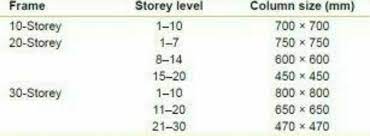
For the 10 storey building the size of column will be 700 x 700 mm. while for the 20 storey building the size of column for the first seven (1 to 7) storey the dimension of column will be 750 x 750 mm and after seven to fourteen (8 to 14) for 20 storey building the size of column will be 600 x 600 mm while for 15 to 20 storey the dimension of column will be 450 x 450 mm.
Alignment of column:
The grid is prepared in survey of placing the columns. This grid helps to avoid the errors as well as placing of columns could be implement suitably also the columns can easily be placed in two different manners that that is given below:
- The straight line can be done by the help of a grid.
- The circular or curvature is used in circular buildings.
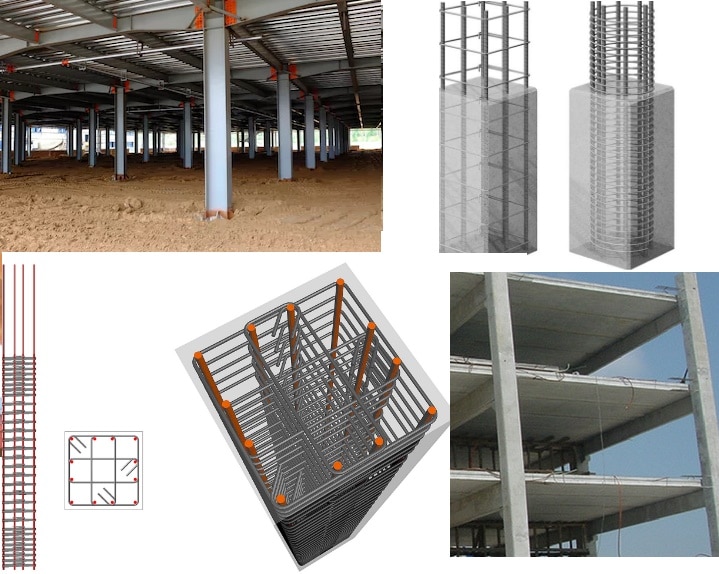
The askew or irregular arrangement of columns instead of straight is fully incorrect structural design. Moreover, it must be considered that at the time columns are raised, beams are set or joining the columns. Moreover, the askew or irregular arrangement of create different problems that is given below:
- Load is transfer irregularly which results in failure of structure.
- Problems is caused in construction of walls.
- Problems is caused in setting of beams.
- Problem is caused to extend the columns in next slab
Conclusion:
I hope I have discussed all the information about standard size of columns used in Construction in this post.
If you learnt something from it, please be sure to share it with someone who might benefit from it.
If you want to add any information which has missed in this article you can mention it in the comment section.
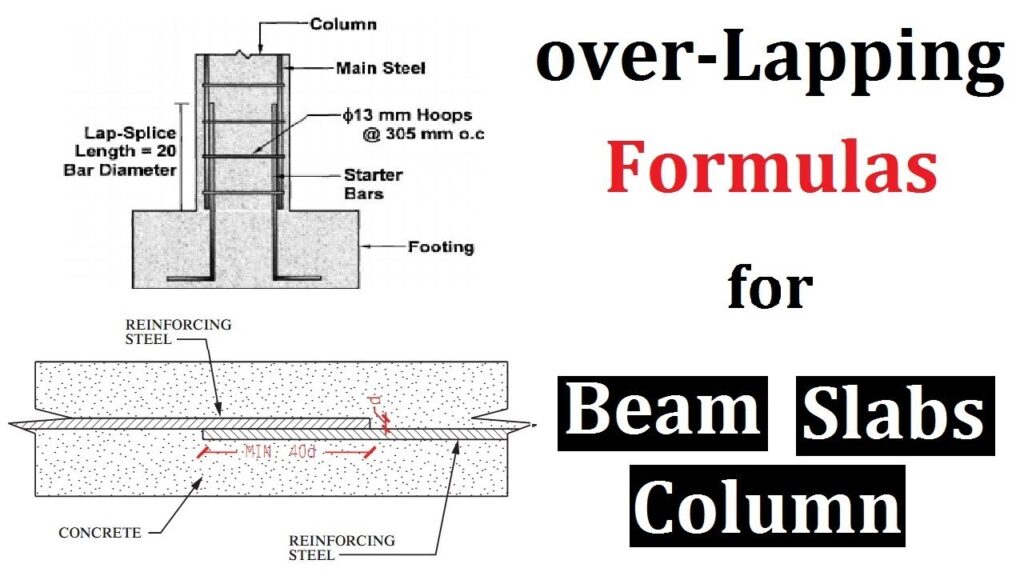
Lap length is one of the important terms in the reinforcement. This is usually confused with another important term called development length and anchorage length.
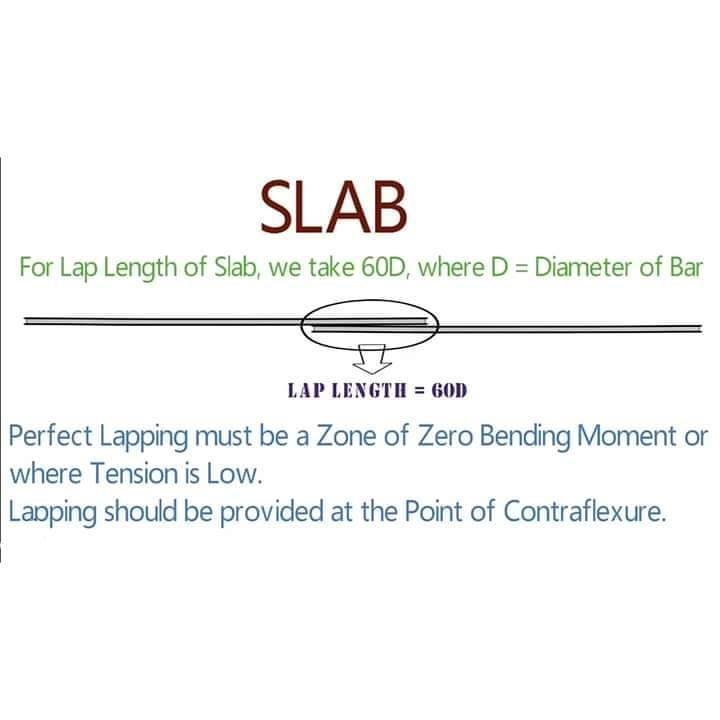
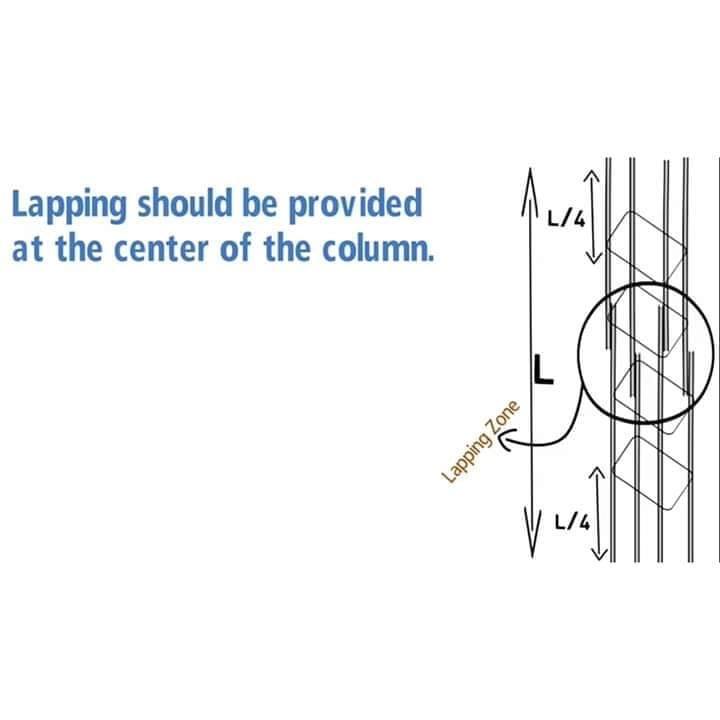
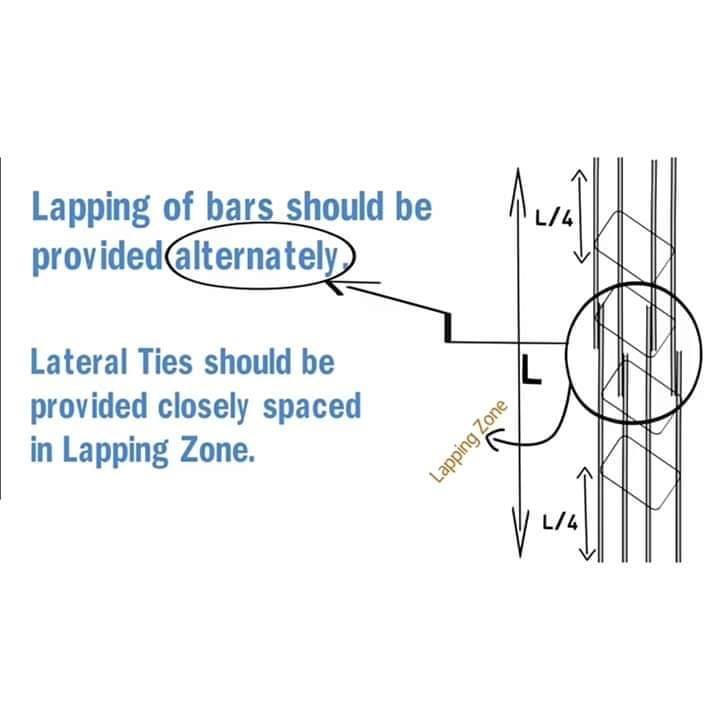
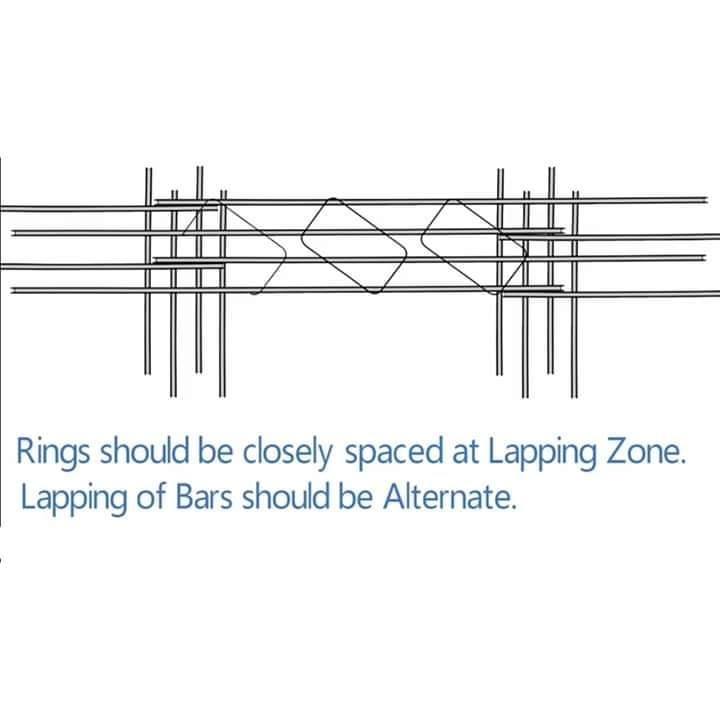
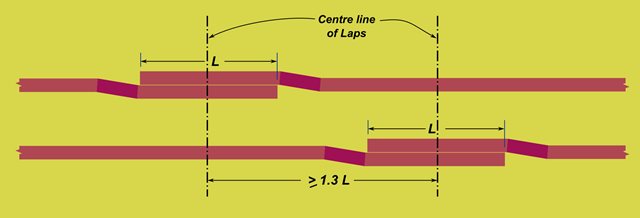
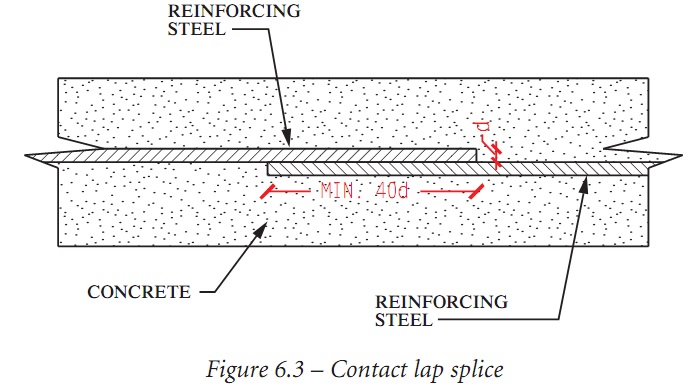
During the placement of steel in a Reinforced concrete structure, if the required length of the single bar might fall short. To get the desired design length, the lapping of two bars side by side is done. An alternative to this is to provide mechanical couplers.
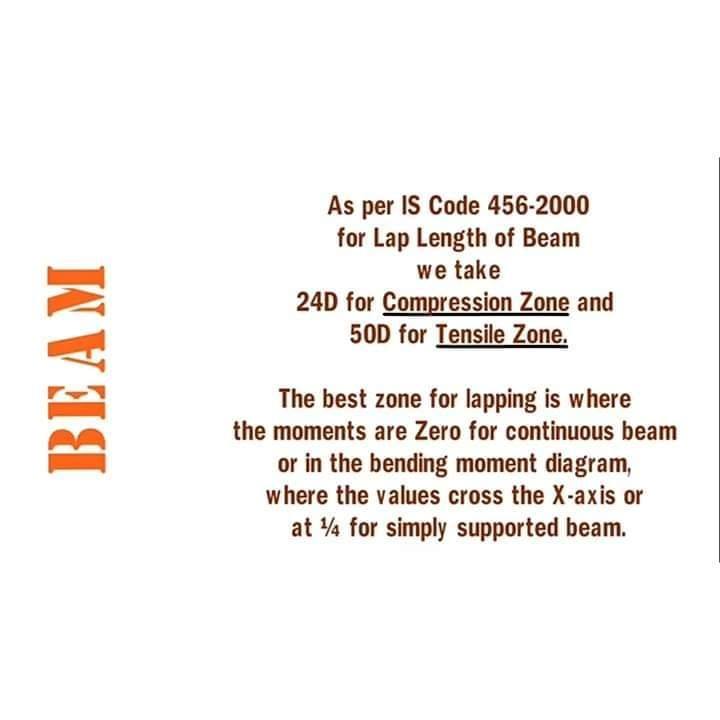
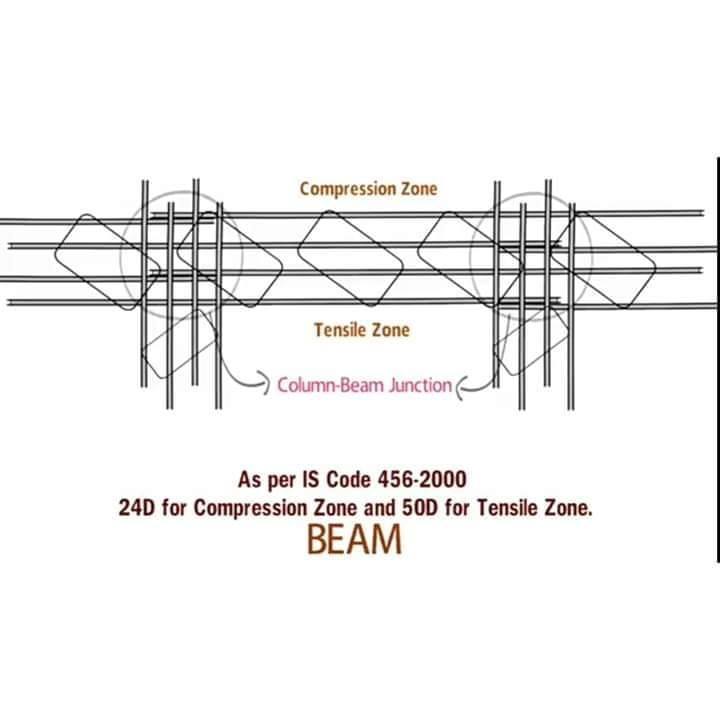
The overlapping of the steel is very important in R.C.C works because splicing of steel is used to transfer all the stresses from one bar to another bar. The length of the lapping is different in different concrete mixes because different concrete having a different crushing strength.
1- The lapping is not provided above 36 mm diameter bars because those diameter bars doesn’t transfer the stresses from one bar to another bar and also the alignment of the column bar is also affected by providing the lap on these bars.
2- The lapping of the steel bars also not provided in high shear force zones and it should be provided at that zone where the shear force will be minimum.
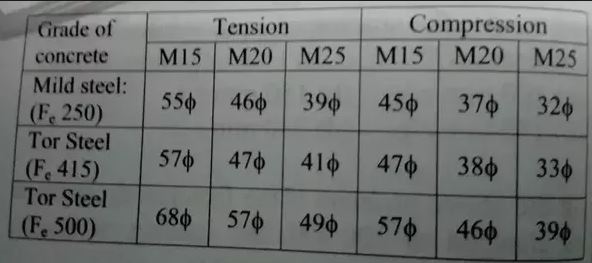
In M 15 Concrete Mix: In M 15 we use the concrete mix 1 : 2: 4 means 1 part of cement, 2 part of sand and 4 part of aggregates.
Tension zone Compression Zone
Fe 250 – 55 ∅ Fe 250 – 45 ∅
Fe 415 – 57 ∅ Fe 415 – 47 ∅
Fe 500 – 68 ∅ Fe 500 – 57 ∅
In M 20 Concrete Mix: In M 20 we use the concrete mix 1: 1.5 : 3 means 1 part of cement, 1.5 part of sand and 3 part of aggregates.
Tension zone Compression Zone
Fe 250 – 46 ∅ Fe 250 – 37 ∅
Fe 415 – 47 ∅ Fe 415 – 38 ∅
Fe 500 – 57 ∅ Fe 500 – 46 ∅
In M 25 Concrete Mix: In M 25 we use the concrete mix 1 : 1: 2 means 1 part of cement, 1 part of sand and 2 part of aggregates.
Tension zone Compression Zone
Fe 250 – 39 ∅ Fe 250 – 32 ∅
Fe 415 – 41 ∅ Fe 415 – 33 ∅
Fe 500 – 49 ∅ Fe 500 – 39 ∅
Where ∅ is the diameter of the bar? Suppose we are using a steel bar Fe 500 and concert mix M25. The diameter of the bar will be 10 mm. By using the formula, the splice length of the steel bar will be 49 x 10 = 490 mm and if the bar is in tension zone and 39 x 10 = 390 mm if the bar is in the compression zone.