Brick Size
Bricks are one of the most utilized and essential building construction materials. The standard brick Size is used to construct a masonry wall that is relatively durable and strong in nature. They are very popular from the olden days to the modern days because of their low cost and durability.
Traditionally, the construction bricks were manufactured from clay soil. The bricks have a long history in past goes as far as 5000 BC. It is utilized by ancient technology were used by Roman, Egyptian and Indian civilizations.
The term brick refers to small units of building material, often made from fired clay and fixed in position by using mortar, a bonding agent comprising cement, sand, and water.

Importance of Brick
Following are points shows the importance of bricks in building construction,
- Fire Protection: Bricks are not very easily affected by fire or catch fire quickly. Bricks made from clay has fire resistance up 2000 degree Fahrenheit.
- Wind Protection: House constructed from bricks are stronger to resist wind force acting on them during Strom compared to fibre and vinyl materials. According to a recent study, brick can bear wind force of more than 80 mph.
- Moisture Control: If bricks are made from the ideal combination of clay, head, and water then they prove to be best in moisture control in the house.
- Minimum Waste: As the bricks are made from a natural clay material that can be reused causes minimum waste.
Brick Orientation
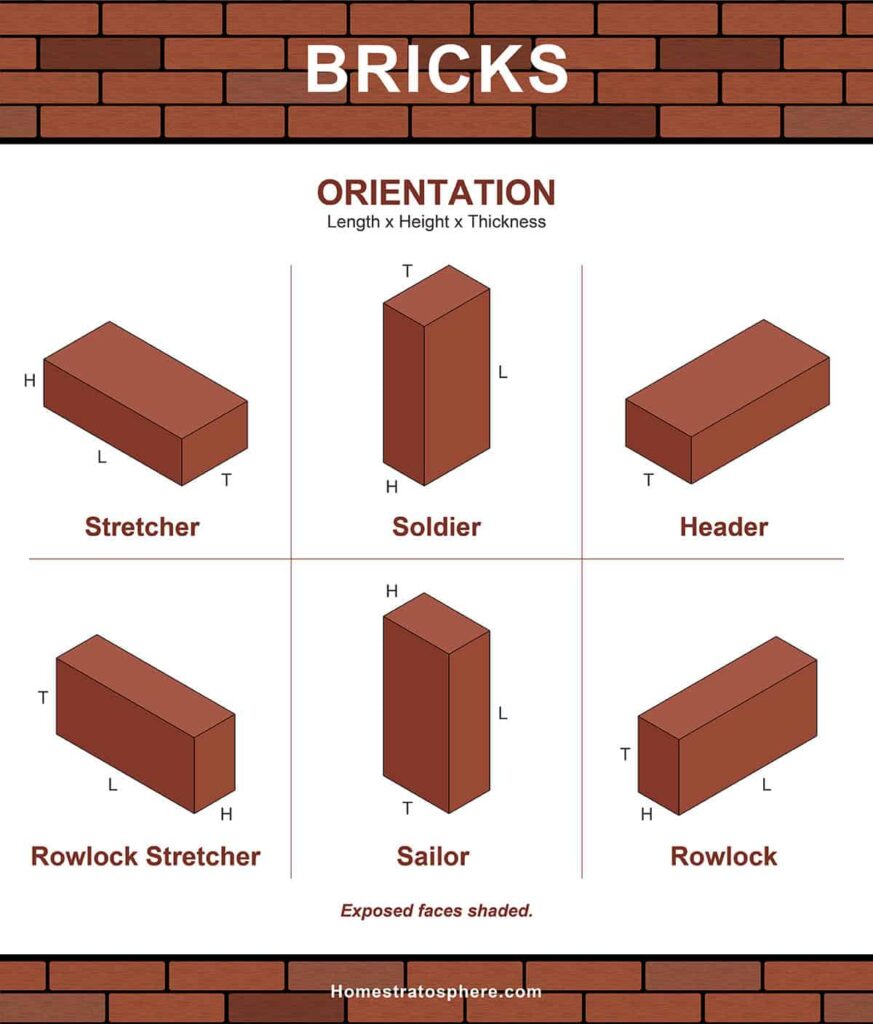
Brick is an element of three-dimension which are length, height, and width which also refer to thickness.
Although brick is three-dimensional, it can be laid in six different orientations.
When the brick is placed on its stretcher, height and length are exposed which is called face dimension.

Brick Standard Dimension and Size
It is important to learn about what are the standard size of brick. To avoid confusion during design and construction, it is important to know about the different dimensions.
Different Dimensions of Bricks
- Specified dimensions.
- Nominal dimensions
- Actual dimensions.

1. Specified Dimensions
- A specified dimension is defined as the dimensions of brick without consideration of mortar.
- In the rational design of brick masonry, structural engineers used them.
- Only specified dimensions are used in non-modular construction if the absence of corresponding nominal dimensions.
2. Nominal Dimensions
- In modular construction, nominal dimensions of bricks are used.
- It is the specified size plus the width of the mortar joint.
- These dimensions produce modules of 4 in. or 8 in. “,
- The building materials such as doors, windows, and wood components have same the modules, which have bricks’.
3. Actual Dimensions
- Actual dimension is defined as the measurement of bricks which is getting from the manufacturing plant of bricks.
- The actual dimensions are within a tolerance of the specified size or dimensions.
- Variation of tolerance is depending upon the type and size of bricks.
- Tolerance is given by the applicable ASTM standard specifications, such as those in ASTM C216, Standard Specification for Facing Brick, and C652, Standard Specification for Hollow Brick.
Standard Size of Brick In India

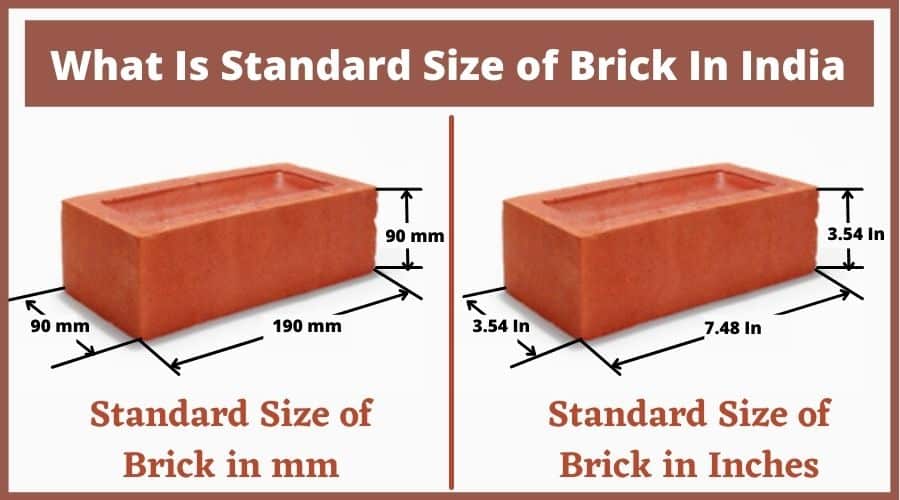
Standard Size of Brick In India: 19 × 9 × 9 cm and 19 × 9 × 4 cm is the standard size of Brick which is also known as modular brick.
19 × 9 × 9 cm brick, when placed in masonry with mortar, it becomes 20 × 10 × 10 cm which is size of brick with mortar.
Standard Size of Brick in mm is 190 x 90 x 90 mm (Length x Width X Thickness)
Standard Brick Dimensions Inches is 7.48 In X 3.54 In X 3.54 In (Length x Width X Thickness)
However, in most parts of the country, the bricks available still are 9″×4”× 3” which also known as field bricks. The weight of such a brick is 3.0 kg.
The frog is provided in brick. The Purpose behind providing frogs is to form a key, to hold the mortar, so the bricks are laid with frogs on top of size 10 × 4 × 1 cm.
- For 4 cm high bricks and extruded bricks, the frog is not provided.
- The shape of brick is rectangular; it can be conveniently handled with one hand.
- The length, width, and height of brick are as given below:
- The length of a brick is equal to twice the width of the brick plus the thickness of the mortar
Height of brick = width of the brick
Different Types of Bricks and Their Standard Size In India
The following are some standard bricks types and Their standard size in India.
- Modular bricks
- Non-modular bricks
- English size bricks
- Conventional bricks

Bricks Dimensions
1. Modular Bricks
The Brick along with cement mortar joints is called Modular brick,
Standard size of brick in India, 190 mm × 90 mm × 90 mm, is The standard modular size of common building brick with specification (length × breadth × height)
These are machine-made bricks.
2. Non-Modular Bricks
230mm × 110mm × 70mm & 230mm × 110mm × 30mm is the size of Non – modular bricks that may be used.
3. English Size Bricks
English size brick, which is commonly used in India is 230mm × 115mm × 75mm
4. Conventional Bricks
Conventional bricks, which is commonly used in India is 230mm × 110mm × 110mm
What Is Frog

The Frog is a depression made on the top surface of bricks which is useful for making a strong bond between upcoming layers of bricks.
The Frog Should Be 10 – 20 mm Deep.
It enhances the Brick Bondings with Mortar.
The Standard Size Of Burnt Clay Bricks
The bricks are made by burning clay in a kiln. The standard size of burnt clay brick has been mentioned in IS Code.

1. Heavy Duty Burnt Clay Bricks (IS 2180)
These bricks are similar to burnt clay bricks, and they both have the same size but it has high compressive strength.
Dimension of Heavy Duty Brunt Clay Brick
Following table shows the standard dimension of heavy duty brunt clay bricks,
| Length (mm) | Width (mm) | Height (mm) |
| 190 | 90 | 90 |
| 190 | 90 | 40 |
The Following table shows maximum permissible tolerance for brick dimensions,
| Dimensions (mm) | Tolerance on Individual Bricks |
| 190 | + 4 |
| 90 | + 2 |
| 40 | + 2 |
2. Heavy Clay Perforated Bricks (IS 2222)
- They have cylindrical holes throughout their thickness, high compressive strength, and less water absorption.
- The burning of these bricks is easy and economical.
- These bricks are also light in weight and require less quantity of clay.
- Vertical or horizontal can be the direction of perforations.
- These are used in building walls and partitions walls.
- Larger dimensions should be parallel to the longer side of the brick in case of rectangular perforations.
Dimension: Heavy Clay Perforated Bricks are available in the following sizes. (i) 190 × 90 × 90 mm. (ii) 290×90×90 mm
Tolerances:
| Dimensions (cm) | Tolerances (mm) |
| 290 | + 10 |
| 190 | + 7 |
| 9 | + 4 |
3. Burnt Clay Paving Bricks (IS 3583)
These bricks contain more iron content than that ordinary clay bricks.
Due to Excessive iron vitrification of bricks is found, while burning at a low temperature, which gives natural glaze to the brick, so which helps to make it more resistant to abrasion
From surface clay, impure fire-clay, or shale, paving bricks can be manufactured. For paving bricks, shale is the best raw material. They are burning seven to ten days continuously in the kiln.
Dimensions: The Standard Dimension of Burnt Clay Paving Bricks or Sizes are i) 195 × 95 x 90 mm, (ii) 195 × 95 × 40 mm.
Tolerances:
| Dimensions (cm) | Tolerances (mm) |
| 195 | + 6 |
| 95 | + 3 |
| 90 | + 3 |
| 40 | + 1.5 |
4. Burnt Clay Soiling Bricks (IS 5779)
These are used for soling of roads.
Dimension: Burnt Clay Soiling Bricks are available in the following sizes. (i) 190 × 90 × 90 mm. (ii) 290 × 90 × 40 mm