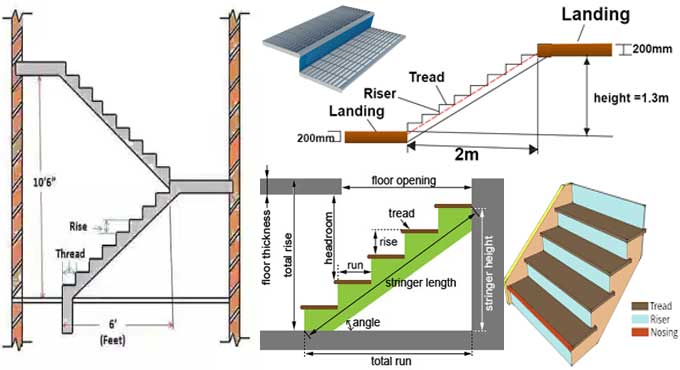
A staircase provides easy access from floor to floor. A staircase is a room or space that contains stairs. Stairway Design Calculation is necessary before constructing stairs to determine their risers and tread positions.
Buildings with multiple floors have staircases for access and communication. Fires spread from floor to floor with the help of these paths.
As a result, the structure must be protected by fire-resistant walls, floors, and ceilings. In the same way that floors are designed to carry specific loads, the frame will have to carry certain loads. Stairs can be built from a variety of materials such as timber, bricks, stone, steel, or reinforced cement concrete.
Tread: As you go up or down stairs, you place your foot on the top portion of the step is called Tread.
Riser: Step treads are supported by this vertical portion is known as Riser.
Points to Consider When Calculating Tread and Riser
The reason for 10 inches of tread is that everyone wears slippers that may be up to 10 inches in length for an average adult person, so you want to make sure the treads are no shorter than 10 inches in length.
A 5-inch rise may be considered normal in construction buildings where stairs are mostly used by the ill or elderly where they have to climb without using the full amount of energy. That will make it easier to access the riser. It is also important that the tread is wide enough.
Calculation of Riser and Treads of Staircase
There must be equality between every tread and riser. It is better to adjust with a calculator than to adjust one or two stair dimensions. You calculate the rise and treads of stairs by measuring the distance between the landing, where the bottom step rests, and the upper finished floor.
A total rise calculated by dividing it by the desired riser height. Round up or down if the result is a fraction. The height of the riser is determined by dividing the total rise by that number. A dimension to determine first before planning any stair is the rise and tread of the steps and their number.
The following points need to be considered before learning about rise and thread fix:
Two-floor clear distance (A) is 3.20 meters.
Distance between first and last riser on one flight (B) = 1.80m.
Staircase Riser Calculation
Decide the size of the riser first,
The riser size is 7 inch & range is 6-8 inch.
Risers = Clear Distance between Two Floors (A) / Risers Size
= 10foot 6 inches= 126 inches/ 7
= 18 nos.
It’s 9 for the first flight and 9 for the second flight.
Staircase Tread Calculation
The next step is to calculate the tread size. Obviously, there is a difference in treads between a single flight and several rises for any stair. Depending on the type of stair, this dimension can be changed.
Formula for Riser Tread
Number of threads per flight = No. of risers per flight – 1
= 9 – 1
= 8 nos.
Thus, Tread Size = Total Stair Width / No. of Threads
= 6 foot = 72 inches/ 8
Tread size = 9 inch
Precautions: When calculating the design of staircases, here are some things to keep in mind:
- All parallel steps in a building should have the same tread and riser sizes on each floor.
- Any stair or step should have a minimum of 2 m of vertical space.
- For general safety reasons, a flight should usually not have more than 12 risers.
- 850 mm is the minimum width for the staircase. There may be three standard widths for stairs: 1.1 m, 1.6 m, and 1.9 m.
- Buildings used by the public, such as malls, cinemas, and shopping centers, may require wider stairways.

Introduction
- Estimating or estimating is the process of calculating the quantities of various items of works involved in the project.
- Estimation is the technique of calculating or computing the various quantities and the expected expenditure to be incurred on a particular work or project.
- Estimate is a document which furnishes the quantities of different works involved, their rates and the expenditure anticipate in a project.
Necessity of Estimation
- Estimates give an idea of the cost of the work and hence its feasibility can be determined i.e., whether the project could be taken up with in the funds available or not.
- Estimate is required to invite the tenders and quotations and to arrange contract.
- To know about the approximate cost of the building construction.
- To calculate the tax of the building.
- To arrange the labors of the construction works.
- Estimate is also required to control the expenditure during the execution of work.
- Take the approval for the government projects.
- To having the loan from the bank.
Types of Estimate
- Preliminary or approximate estimate
- Detailed estimate
- Supplementary estimate
- Rough cost estimate based on cubic contents
- Complete estimate
- Rough cost estimate based on plinth area
- Annual repair estimate
- Special repair estimate
- Revised estimate
Preliminary or Approximate Estimate
- This estimate is prepared to decide financial aspect, policy and to give idea of the cost of the proposal to the component sanctioning authority.
- It should clearly show the necessity of the proposal and how the cost has been arrived at.
- The estimate which is prepared using any rough method to get approximate cost of the construction anticipate in a project is called approximate estimate.
Detailed Estimate
- After getting administrative approval on rough cost estimate, detailed estimates are prepared.
- In this, the estimate is divided in to sub-heads and quantities of various items are calculated individually.
- The detailed estimate shall also provide for the cost of approach road, water supply, electric installation and acquisition of land etc., so as to call it a comprehensive estimate.
Supplementary Estimate
- This is fresh detailed estimate in addition to the original sanctioned estimate prepared when additional works are deemed necessary during the progress of a work to supplement the original works.
- The abstract of cost should show the amount of the original sanctioned estimate as well as the supplementary amount of the original sanctioned estimate as well as the supplementary amount for which sanctioned is required.
Rough cost estimate based on cubic contents
- The cubic contents of a building means plinth area x height of the building. The height is taken from top of floor level to top of roof.
- The cubic contents of the proposed building are multiplied with cubic rates arrived at for the similar construction i.e. total cost of construction divided by cubic contents=cost per cubic meter.
Complete Estimate
- The estimate which includes, in addition to the cost of construction, the cost of land, the expenses towards surveying, preparation of plans and estimates, legal assistance, registration of documents, payment of taxes and service charges, etc. is called complete estimate.
Rough cost estimate based on plinth area
- Plinth area of a building means Length x breadth excluding plinth offsets. The estimates are prepared on the basis of plinth areas of the various buildings proposed to be constructed.
- The rates are being arrived at the dividing the total cost of construction with its plinth area.
Annual maintenance estimate
- Annual maintenance estimates are being prepared by the concerned department for getting allocation of funds made in the annual budgets.
- In order to keep building and roads in perfect condition, annual repairs should be carried in case of a building as well as a road.
Special repair estimate
- If the work cannot be carried out of the annual repair funds due to certain reasons resulting in the genuine increase in cost, then special repairs estimate is to be prepared.
- The reason of increase may be case of building as well as roads.
Revised estimate
- When the sanctioned estimate exceeds by 5% either due to the rate being found insufficient or due to some other reasons, a fresh estimate is prepared which is called a revised estimate.
- A comparative statement on the last page of the estimate is attached giving there in the reasons of the increase of cost in case of each item.